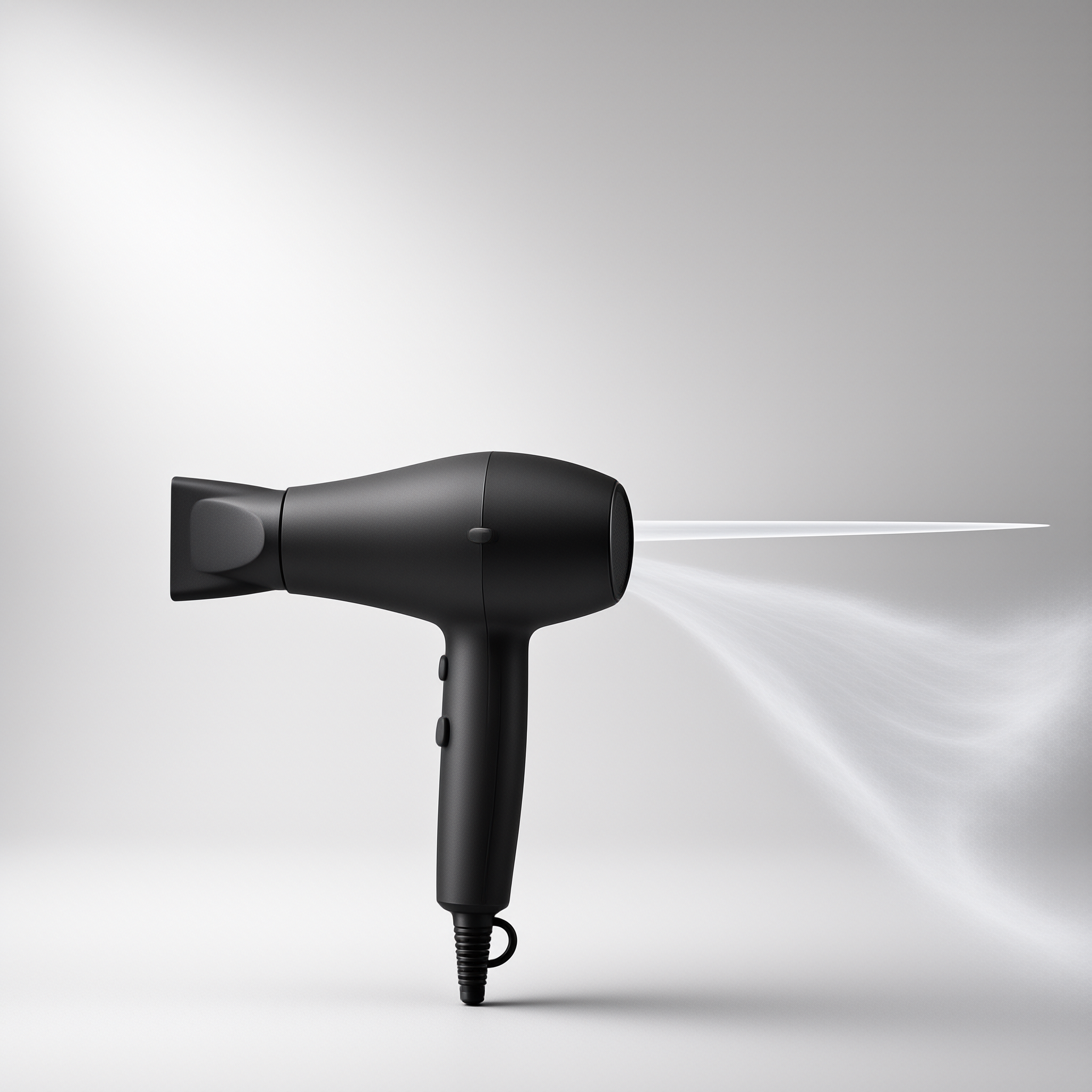
Air velocity and air volume are two different measurements, and confusing them is the most common sourcing error on a high airflow hair dryer. Velocity, in metres per second (m/s), is how fast air leaves the grille. Volume, in cubic metres per hour (m3/h) or CFM, is how much air the unit moves in that hour.
Velocity lifts and separates hair strands; volume clears moisture-laden air away from the head. A model that scores well on only one of the two usually disappoints in real use. The airflow path — inlet, impeller, heater, outlet grille — decides how the two numbers relate to each other.
Velocity moves hair, volume moves moisture — a dryer needs both, or it dries fast in one spot and slowly everywhere else.
Key Takeaways
Air velocity (m/s) measures outlet speed; air volume (m3/h or CFM) measures total flow per hour.
Doubling outlet speed at constant flow needs roughly four times the air power.
A narrow concentrator trades coverage for reach; a wide outlet trades reach for coverage.
Compare airflow figures only when test distance, heater state and nozzle are stated.
MOQ starts from 100 units per model, with models and colours combinable in one order.
Velocity Is Speed, Volume Is Throughput — and Drying Needs Both
Air velocity is a speed measurement taken at the outlet; air volume is a quantity measurement taken over an hour. Both describe the same stream from different angles, and drying performance depends on the pair.
A fast stream carries more kinetic energy per unit of air, so it breaks the surface film on wet hair and pushes strands apart. A large volume keeps replacing the saturated layer of humid air that otherwise sits against the scalp. Those two jobs happen in different parts of the head at the same time.
The relationship is fixed by fluid mechanics: air power scales with volumetric flow multiplied by the square of air speed, derived from the kinetic energy flux formulation (power = ½ × density × flow × velocity squared). Doubling outlet speed at constant flow therefore requires roughly four times the air power. That is why high-velocity claims tend to arrive on a higher-wattage barrel rather than a smaller one.
How to Read Airflow Specs: m/s, m3/h and CFM on One Sheet
What m/s Tells You: Outlet Air Speed
A metres-per-second figure is a point measurement: the speed of the stream at one stated distance from the grille. It tells you how far the stream will reach and how strongly it will lift a section of hair.
Speed decays with distance, so a reading taken close to the grille always looks better than one taken further out. Ask the supplier for the measurement distance before ranking two m/s figures against each other.
What m3/h and CFM Tell You: Total Air Volume
Cubic metres per hour and cubic feet per minute are both volumetric flow units — metric and US convention respectively. The conversion is fixed under ISO 80000: 1 m3/h equals approximately 0.5886 CFM, and 1 CFM equals approximately 1.699 m3/h.
Knowing how to read hair dryer airflow specs means converting both sheets into one unit first, then checking whether the test conditions match. A hair dryer airflow CFM vs m/s comparison is only meaningful after that step, because the two units answer different questions about the same barrel.
Why Neither Number Stands Alone
Air density is approximately 1.2 kg/m3 at 20 °C and standard sea-level pressure (ISO 2533). A volumetric figure describes a volume of air at some density, so altitude, intake temperature and even a warm test room shift the reading on the same unit.
That makes a bare number impossible to benchmark. Ask for distance, heater state and nozzle configuration alongside the figure. Without them, a higher number may only describe an easier test.
High Velocity vs High Volume: Where Each One Wins
High velocity wins on reach, lift and sectional control. High volume wins on moisture removal, gentleness across a large head of hair, and rough-drying speed.
A concentrator forces the same mass flow through a smaller cross-section, so the stream speeds up and delivers its heat into a narrower footprint. A wide outlet spreads that flow, lowering speed but covering more hair at once. Higher airflow shortens total heat exposure, yet a concentrated stream held still will over-dry one spot regardless of volume.
| Dimension | High Velocity (narrow outlet, concentrator) | High Volume (wide outlet, diffuser) |
|---|---|---|
| Best for | Round-brush styling, root lift, section-by-section finishing | Rough-drying long or dense hair before styling |
| Heat concentration | High in a small footprint — the dryer must keep moving | Spread wider, so peak temperature at any point is lower |
| Drying speed per section | Faster on a single section | Faster across the whole head |
| Noise character | Higher pitch from the restricted outlet | Lower pitch, broader whoosh |
| Risk if misused | Over-drying one spot when held still | Longer exposure if the heat setting runs too high |
| Nozzle to specify | Concentrator in the box, plus a diffuser for curls | Wide outlet with a diffuser included |
Choose velocity if the routine ends with a round brush and a concentrator on medium heat. Choose volume if the routine is rough-drying long or dense hair before styling, because continuous air replacement does most of the work. The air velocity vs air volume decision is a routine decision, not a spec-sheet decision.
High-Speed Brushless Motor vs Conventional AC Motor: Airflow Profile Compared
A brushless digital motor pairs high outlet pressure with low weight. A conventional AC motor delivers stable volumetric flow at lower cost and noticeably more mass in the hand.
A small, fast impeller generates higher static pressure, which is what holds flow through a narrow concentrator, a dense inlet filter or a long internal path. An AC motor turns slower in a larger housing, so it moves air with a broader, lower-pressure profile. Pressure holds up against restriction; volume fills a wide space.
Weight in hand: brushless is clearly lighter at the same airflow target.
Upfront unit cost: AC remains cheaper at comparable volumetric flow.
Behaviour through a concentrator: brushless holds flow better because it has more static pressure.
Noise: brushless runs at a higher pitch; AC runs louder at a lower frequency.
Durability: brushless has no carbon brushes to wear, which matters more on high-duty salon use than on occasional home use.
Serviceability: AC motors and their wiring are easier to source and replace in the field.
Airflow can rise without a bigger motor, but not for free. Opening the inlet or trimming the outlet restriction usually moves the problem to noise and vibration; the workable route is a tuned diffuser and a redesigned internal airflow path. Because that touches the housing tool, it sits in the higher, tooling-dependent MOQ bracket rather than the standard 100-unit-per-model bracket.
Static pressure decides what survives a concentrator; raw volume decides how fast a whole head dries.
Why a High-Airflow Dryer Can Still Feel Weak
A unit can quote a strong airflow figure and still feel weak in use. The usual causes are inlet restriction, nozzle back pressure, holding distance and supply voltage — usually in that order.
A clogged inlet filter starves the impeller, and no motor setting recovers flow that never enters the barrel. A narrow concentrator raises back pressure, cutting volumetric flow even as outlet speed rises. Holding the dryer too close creates turbulence that stalls the stream against the scalp; holding it too far lets the stream decay before it reaches the hair.
Work through it in sequence: clean the inlet filter, run the unit with no nozzle attached, test at two distances, then test the same unit on a different circuit. If the reading only recovers on the second circuit, the cause is supply voltage, not the dryer.
Spec-Sheet Red Flags: How to Audit an Airflow Claim Before You Buy
Treat an airflow number as incomplete until five things are stated: measurement distance, heater state, peak versus sustained, the unit used, and the nozzle fitted. Any sheet missing two or more of these cannot be benchmarked.
A heater element in the airstream adds resistance and raises air temperature, which changes both density and flow through the barrel. A cold reading and a hot reading on the same unit will differ, so a supplier quoting the more flattering state is not necessarily quoting a stronger dryer. Units compound the problem: a m3/h figure and a CFM figure look far apart until you convert them.
Verification on assembled units should follow a fixed routine, not a one-off spot check. Hold the anemometer at a set distance from the outlet grille, switch the heater and ion generator off, take readings at maximum and medium settings, and record the nozzle fitted during each reading. Comparing a heater-on figure with a heater-off figure is the single fastest way to produce a spec sheet that cannot be defended in a buyer meeting.
Specifying an EU Plug Model: Voltage, Plug Type and Airflow Target
Voltage and Frequency: 220-240 V at 50 Hz
EU mains is nominal 220-240 V at 50 Hz, and the whole design should be specified to that window rather than to a single figure. A 120 V design run on EU supply will fail; an EU design run on 120 V will underperform and may not start.
Motor speed and heater power both scale with supply voltage, so the airflow target moves with the voltage band. Specify the airflow figure at nominal voltage and state the tolerance, or the sample you approve and the production unit you receive will not match.
Plug Type: Europlug vs Schuko
Two plug bodies matter for an EU plug hair dryer: the CEE 7/16 Europlug, a flat two-pin Class II plug, and the CEE 7/7 Schuko, an earthed round plug.
At 230 V, a full-power dryer draws far more current than a Europlug is rated to carry, so that body does not suit high-wattage models. Schuko, or a hybrid plug that mates with both socket families, is the safer specification line for a high airflow unit.
Cord Length, Marking and Documentation
Cord length and strain relief belong on the specification, not on the accessory list. Short cords get returned; poor strain relief becomes a safety claim. EU market compliance checks start with the marking and documentation set, so verify that set before the carton is sealed.
How the airflow target interacts with all of this is simple: at the bottom of the voltage tolerance band, motor speed drops and outlet speed falls with it. Quote the target at nominal voltage, then confirm plug, cord length and marking set against it — on an EU plug hair dryer those lines ship together or the model is not launch-ready.
Sourcing a High Airflow Hair Dryer from a China Manufacturer: Samples, MOQ and Lead Time
MOQ starts from 100 units per model, and models and colours can be combined in one order. Samples ship in 7 days; bulk lead time is 25-35 days.
A brand owner preparing an EU launch typically has two candidate designs on the table: a compact barrel quoting a high outlet velocity through a narrow concentrator, and a wider barrel quoting a larger volumetric flow at lower speed. Both sheets look impressive. The decision hinges on the target user's routine, the nozzle set supplied in the box, the plug and voltage configuration for the destination market, and whether the housing can be modified within the project's tooling budget.
Housing or airflow modification moves the MOQ into a higher, tooling-dependent bracket, so confirm the tooling budget before shortlisting a design. With a hair dryer manufacturer in China, the practical sequence is: approve the airflow target and its test condition, approve the nozzle set, approve the plug and cord, then place the order. On high airflow hair dryer MOQ, a stock shell costs one sample round; a modified shell costs a tool.
Frequently Asked Questions
- What is a good air velocity for a high airflow hair dryer?
- There is no single target number that means anything on its own. Read velocity together with volume, nozzle type and measurement distance, and ask for the test condition before comparing suppliers.
- Is m3/h or CFM the better unit to quote on a spec sheet?
- Both are volumetric units; the difference is regional convention. Whichever one is used, the test method and heater state must be stated alongside it.
- Does a high-volume dryer dry hair faster than a high-velocity one?
- Volume replaces humid air around the hair, while velocity lifts and separates strands. The fastest result usually pairs moderate volume with controlled velocity and sufficient heat.
- How is airflow measured on a production unit?
- Hold an anemometer at a fixed distance from the outlet grille with the heater and ion generator off, read at maximum and medium settings, and record the nozzle fitted for each reading.
- Can I combine models and colours in one order?
- Yes. MOQ starts from 100 units per model, and models and colours can be combined in one order. Housing or airflow modification carries a higher, tooling-dependent MOQ.
- Which certifications should an EU plug model carry?
- Look for CE, RoHS, UKCA and CB where applicable, alongside FCC and ETL for other markets.
The decision framework fits on one page: fix the routine, pick velocity or volume to match it, specify the nozzle and heat setting with the number, then audit the test condition before ranking suppliers. Buyers who work in that order stop arguing about spec sheets and start comparing a high airflow hair dryer that genuinely suits the market they are selling into.
A higher airflow number means nothing until test distance, heater state and nozzle are stated alongside it.
About highdryer
highdryer is a high-speed hair dryer manufacturer based in Dongguan, China, established in 2009. Our 30,000 sqm facility runs 15 production lines with 300+ staff and a daily capacity of 20,000 units. We support OEM/ODM with logo, colour, packaging and manual customization. MOQ starts from 100 units per model, and models and colours can be combined in one order. Samples ship in 7 days; bulk lead time is 25-35 days. Payment terms: T/T, L/C, Western Union. Certifications: CE, FCC, RoHS, CB, UKCA, ETL, ISO 9001. Contact us for a quotation against your specification.