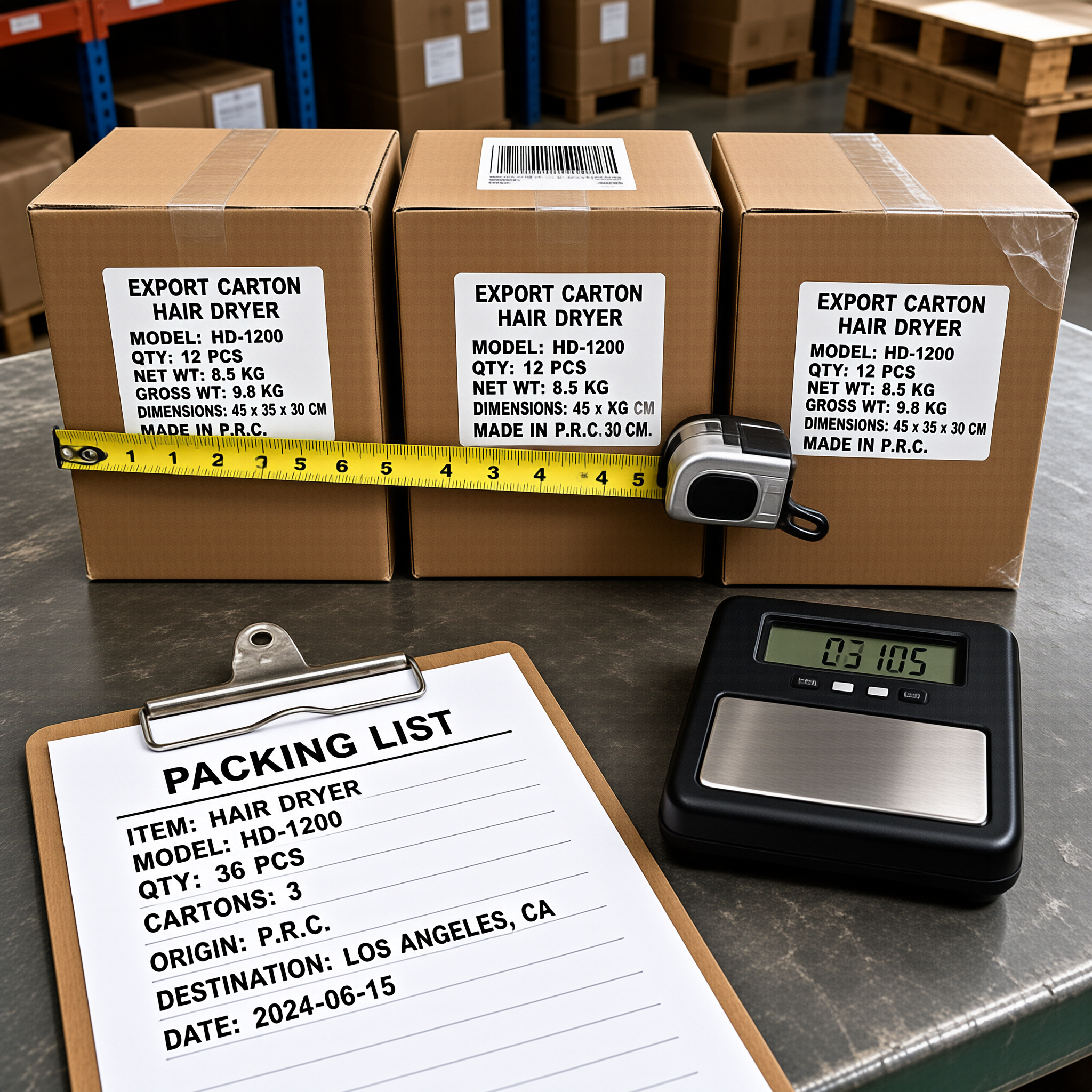
For most first orders, air freight is the safer choice. A 100-unit order packs into five cartons, roughly 0.47 CBM, and air transit runs 3–7 days against 20–35 days by sea. Sea freight wins on cost per unit only once volume fills a consolidator's minimum. Below that, air keeps your cash cycle short and your launch date predictable.
Key Takeaways
Air freight suits first orders of 100–300 units: transit is 3–7 days and chargeable weight stays close to actual weight at this packaging density.
Sea LCL pays off when the shipment fills the consolidator's minimum volume; transit is 20–35 days port to port.
Chargeable weight is the higher of actual gross weight and volumetric weight, using a divisor of 167 kg per CBM for air cargo.
One carton of 20 hair dryers measures 58.3 × 34.5 × 47 cm, grosses 16 kg and volumes out at about 15.8 kg, so actual weight governs the billing.
Both modes need the same core documents and the same CE, RoHS, FCC and CB conformity paperwork, so the decision is about time and cash, not compliance.
Definition
Hair dryer shipping and freight decisions for first orders describe the choice between air cargo, priced on chargeable weight with 3–7 day transit, and sea LCL, priced per cubic metre with 20–35 day transit, when importing an initial batch of styling appliances.
Air Freight: How Chargeable Weight Actually Works
Airlines and forwarders do not bill the weight you can read off a scale. They bill chargeable weight, which is the higher of actual gross weight and volumetric weight. That one rule decides whether a carton of hair dryers is treated as dense cargo or as space-consuming cargo, and it changes the quote far more than the headline rate per kilo. Rate structures and billing conventions are maintained by IATA Cargo.
The Volumetric Weight Formula
For air cargo, divide the carton volume in cubic centimetres by 6,000, or multiply cubic metres by 167. Express and courier services use a divisor of 200 kg per CBM instead, which is why a single sample carton can cost more by courier than the same carton moved as air cargo. Ask which divisor a forwarder applies before comparing two quotes; the calculation basis behind air cargo charging is well documented in transport research indexed on Google Scholar.
A Worked Example Using Our Own Cartons
Take the standard hair dryer carton: 58.3 × 34.5 × 47 cm. That is 0.0945 CBM, which volumes out at 15.8 kg against a gross weight of 16 kg. Chargeable weight is therefore 16 kg, and the carton is dense enough that you pay for what you actually ship. Multiply by five cartons for a 100-unit order and the shipment is 0.47 CBM, 80 kg actual, 80 kg chargeable.
| Model | Pcs per carton | Carton size (cm) | Gross weight | CBM per carton | Volumetric kg | Chargeable kg |
|---|---|---|---|---|---|---|
| Hair dryer | 20 | 58.3 × 34.5 × 47 | 16 kg | 0.0945 | 15.8 | 16.0 |
| HS09 styler | 10 | 57 × 43 × 37.5 | 15 kg | 0.0919 | 15.35 | 15.35 |
| HT01 straightener | 15 | 47 × 41 × 43 | 14.1 kg | 0.0829 | 13.84 | 14.1 |
Note where the line falls. The styler carton is lighter relative to its volume, so volumetric weight governs and you pay 15.35 kg for a 15 kg carton. Run a mixed first order and the chargeable total is the sum of each carton's higher figure, not the higher figure of the whole shipment.
Sea Freight: Where LCL Makes Sense
LCL is priced per cubic metre, but consolidators apply a minimum charge per shipment, so a half-pallet often pays close to what a full pallet pays. Published transit of 20–35 days is port to port and excludes booking cut-offs, customs clearance at both ends and inland delivery. Build your launch date from the day goods reach your warehouse, not the day they leave the factory. Country-specific import formalities are summarised in the ITA Country Commercial Guides.
Sea freight earns its place when the first order is large enough to take a meaningful share of container space, or when you are launching several models together and can accept a slow first cycle in exchange for a lower freight cost per unit. For a genuine market test, the weeks saved by air are usually worth more than the freight difference.
Air vs Sea: Side-by-Side Comparison
| Factor | Air freight | Sea LCL |
|---|---|---|
| Transit time | 3–7 days door to door | 20–35 days port to port |
| Pricing basis | Chargeable weight (higher of actual and volumetric) | Cubic metres, subject to consolidator minimum |
| Volumetric divisor | 167 kg per CBM (courier: 200 kg per CBM) | Not applicable |
| Typical first-order fit | 100–300 units, one to three models | Multi-model launches and buffer stock |
| Cash cycle impact | Goods sell while working capital is still fresh | Stock is tied up in transit for weeks |
| Transport document | Air waybill | Bill of lading |
| Main commercial risk | Cost per kilo on light cartons | Schedule slippage and port congestion |
A Step-by-Step Method for Your First Shipment
Step 1: Fix the order composition. Minimum order is 100 units per model, and colours can be mixed within a model, so settle the model and colour split before asking for freight quotes.
Step 2: Get carton counts from the factory. Divide total units per model by the pieces per carton and round up; 100 hair dryers become five cartons, 100 stylers become ten.
Step 3: Calculate CBM and volumetric weight for the whole consignment using the carton dimensions, then compare against total gross weight.
Step 4: Request one air quote and one LCL quote on identical Incoterms, and state explicitly which volumetric divisor each quote uses.
Step 5: Work backwards from your sales start date. Production needs 25–35 days after deposit and artwork approval, so freight time sits on top of that, not inside it.
Step 6: Book only after the pre-production sample and artwork are signed off, otherwise a re-run will invalidate the freight booking.
Documentation and Compliance Details That Affect Freight
Every first shipment needs a commercial invoice, a packing list, and either an air waybill or a bill of lading. Add a certificate of origin where your destination requires it. The HS classification in the commercial invoice drives duty treatment, and the current nomenclature is published by the World Customs Organization. A vague product description is a common cause of clearance holds, and holds cost more on air than on sea.
On conformity, the file should carry CE, RoHS, FCC and CB documentation for the model and voltage variant you are actually importing. Check that the documents reference the exact model code on the carton, and that plug types match the destination market. Confirm the full scope of each document with your supplier before the goods leave, because reissuing paperwork after departure is the slowest problem to fix.

Frequently Asked Questions
- How is chargeable weight calculated for air freight?
- Multiply the carton volume in cubic metres by 167, or divide the volume in cubic centimetres by 6,000. Compare that figure with the actual gross weight and bill the higher one. A standard hair dryer carton of 0.0945 CBM volumes out at 15.8 kg against a 16 kg gross weight, so 16 kg is charged.
- What is the difference between air freight and sea LCL for a first order?
- Air freight is billed on chargeable weight and delivers in 3–7 days. Sea LCL is billed per cubic metre with a consolidator minimum and takes 20–35 days port to port. Air suits smaller launch batches; LCL suits larger or multi-model orders where slower transit is acceptable.
- How many cartons does a 100-unit hair dryer order need?
- Five cartons, at 20 pieces per carton. That is roughly 0.47 CBM and about 80 kg gross, which keeps the shipment close to the consolidator minimum and usually makes air the cleaner option for a first order.
- Why does volumetric weight matter more than gross weight?
- Because the carrier charges whichever figure is higher. Light, bulky cartons are priced on the space they occupy rather than the kilos on the scale. The HS09 styler carton grosses 15 kg but volumes out at 15.35 kg, so the volumetric figure sets the price.
- What documents are needed for the first shipment?
- A commercial invoice with HS classification, a packing list matching carton counts, and an air waybill or bill of lading. Where the destination requires it, add a certificate of origin. Keep CE, RoHS, FCC and CB files available for the exact model and voltage variant being imported.
- What is the minimum order quantity and lead time?
- Minimum order is 100 units per model, with colours mixable within a model. Lead time is 25–35 days after deposit and artwork approval, and freight transit is additional to that window rather than included in it.