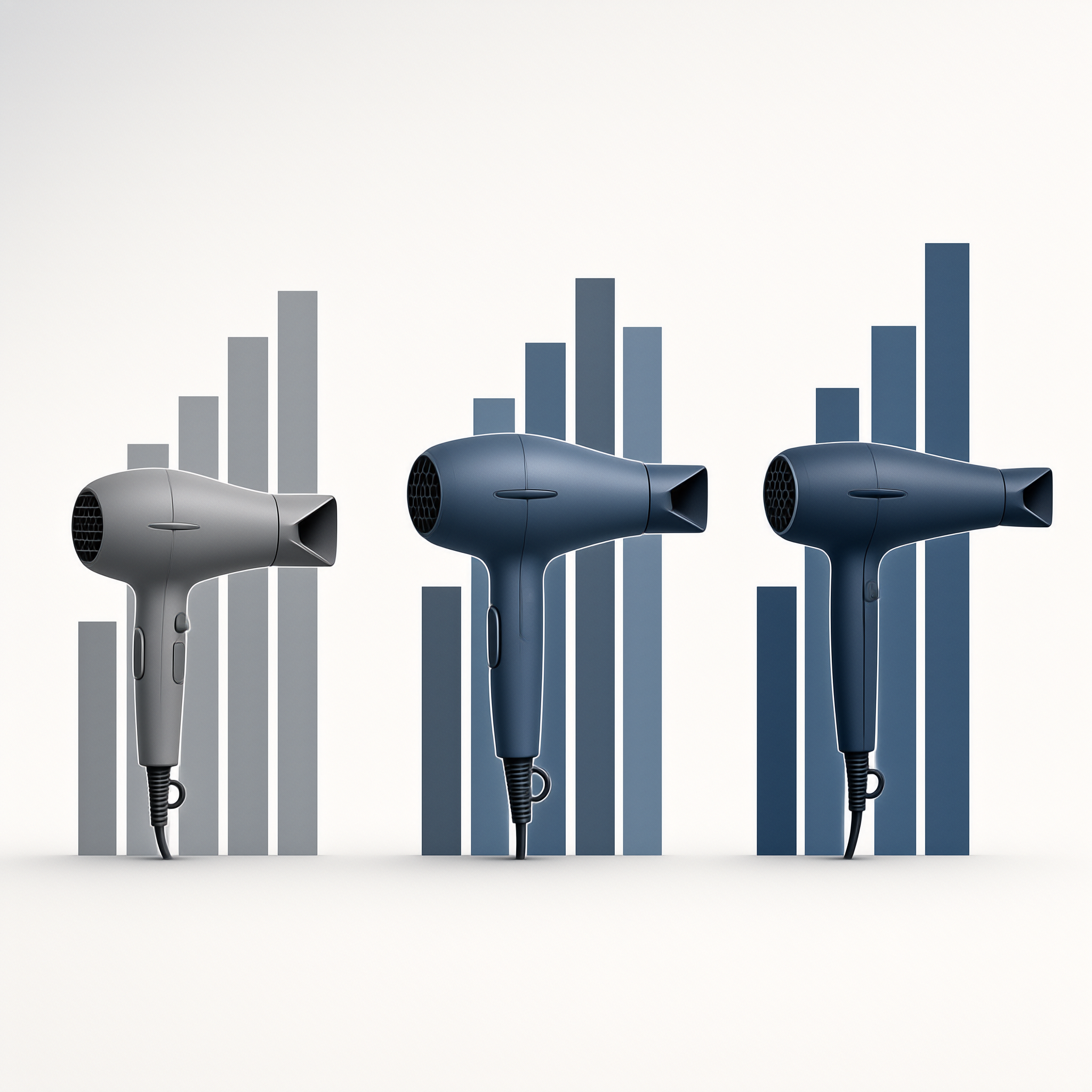
A high-speed hair dryer can run as quiet as a 59 dB maximum at one metre at full speed. That is the figure for the bladeless MY85, and it is a factory self-test result rather than a third-party certified measurement. The high-speed brushless PD01 runs at or below 70 dB.
In practice, hair dryer noise level is decided less by RPM alone than by motor type, impeller design and housing resonance. A faster motor pushes sound energy upward in frequency instead of simply making it louder. Two dryers drawing 1600W can therefore read very differently on the same meter.
A dB figure without a stated distance and speed setting cannot be compared with a competitor's spec sheet.
Key Takeaways
Bladeless MY85: 59 dB maximum at 1 metre at full speed, 1600W, 544 g — factory self-test, not third-party certified.
High-speed brushless PD01: at or below 70 dB, 110000 rpm, 1600W, 465 g — also a factory self-test figure.
Traditional dryers run 20000-30000 rpm; high-speed brushless units run 110000 rpm, which lifts tonal frequency rather than loudness alone.
Any noise cap in a purchase order must state distance and speed setting, or it cannot be enforced at inspection.
Quiet and light do not arrive as a set: the 59 dB bladeless model weighs 544 g, the 70 dB brushless model 465 g.
How Quiet Can a High-Speed Hair Dryer Actually Be?
The lowest ceiling in our current range is a 59 dB maximum, and it comes from a bladeless platform rather than a fan-in-housing unit. Our other high-speed model is rated at or below 70 dB.
A bladeless head accelerates air through an annular slot, so there is no exposed fan face chopping the airstream at a fixed rate. That removes the discrete blade-pass tone which otherwise dominates the sound of a conventional dryer. What remains is broadband airflow noise, which reads lower at the same 1600W input.
The MY85 is listed at 1600W and 544 g with a 59 dB maximum, measured at 1 metre at full speed. The PD01 is listed at 1600W, 465 g and 110000 rpm with a ceiling of 70 dB. Both are internal factory records, not third-party certified.
Hair Dryer Noise Levels by Category: A dB Comparison
When a buyer asks how loud is a hair dryer, the honest answer is that the category matters more than the model badge. Bladeless, high-speed brushless and traditional motor dryers are built around different noise sources and cannot be judged on one number.
Each category generates sound differently. Traditional dryers run 20000-30000 rpm with a brushed motor, so motor hum and blade-pass tone dominate. High-speed brushless designs run at 110000 rpm, where the tone moves into a higher band and the motor adds less contact noise. A useful hair dryer noise comparison has to account for that before the dB figures are laid side by side.
| Category | Drive / rated speed | Noise ceiling (1 m, full speed, factory self-test) | What it means in practice |
|---|---|---|---|
| Traditional AC motor | Brushed motor, 20000-30000 rpm | No ceiling figure published in our data | Lower blade-pass tone, heard as a broad hum; cannot be ranked against our other rows on dB alone |
| High-speed brushless | Brushless motor, 110000 rpm | At or below 70 dB (PD01) | Fastest platform in the range at 465 g; the tone sits higher, so it reads as sharper to the ear |
| Bladeless | Bladeless head, 1600W (MY85) | Maximum 59 dB (MY85) | Lowest ceiling in the range at 544 g; 79 g heavier than the brushless model |
Our published ceilings are 59 dB maximum for the bladeless MY85 and at or below 70 dB for the brushless PD01. We do not publish a ceiling for the traditional category, so that row carries no number. Setting a self-test figure against a competitor's sheet of unknown method is not a comparison at all.
What Actually Makes a Hair Dryer Loud: Five Mechanical Causes
Five mechanical sources set the noise of any dryer: motor type, impeller geometry, airflow path, RPM and housing resonance. Brushless motor hair dryer noise is usually the first item buyers ask about, but it is only one of the five.
Motor Type: Brushed vs Brushless
Brushed motors carry carbon brushes that ride on a spinning commutator. That sliding contact and the small arcs it produces add broadband noise unrelated to airflow. Brushless motors switch electronically, so the brush contact layer disappears entirely.
Removing brush contact does not make a dryer silent. It removes one source and leaves the impeller and the airstream as the dominant ones. On our brushless platform that trade is visible: 110000 rpm with a ceiling of 70 dB on factory self-test.
Impeller Geometry and Airflow Path
Blade count, pitch angle, tip clearance and diffuser shape decide how evenly the impeller pushes air. Tight tip clearance with a matched diffuser keeps flow attached; a loose fit lets it separate and generates turbulence the ear hears as roughness.
The airflow path matters just as much. Every sharp bend, grille bar and gap between impeller and housing adds turbulence. Smoothing that path adds tooling time but lowers broadband noise without touching the motor specification.
RPM, Tonal Frequency and Housing Resonance
RPM sets where the tone sits, not only how loud it is. Raising rotational speed shifts blade-pass frequency upward, and a high tone is perceived as sharper even when the overall reading is unchanged. That is why a fast dryer can sound more aggressive than a slow one at the same number.
Housing resonance is the last layer. Thin or poorly damped shells vibrate with the motor and radiate that vibration outward as sound. Rigid mounting points and damped internal surfaces cut the energy that reaches the shell, which is why two units with identical motors can measure apart.
RPM raises the pitch of a hair dryer more reliably than it raises the volume.
How Hair Dryer Noise Level Is Measured — and Why Factory Figures Differ
A dB hair dryer figure is a sound pressure level reading, normally A-weighted, taken with a sound level meter at a stated distance. Without that distance and the speed setting, the number means very little. Acoustic reporting conventions trace back to internationally recognised acoustics standards, and the underlying physics is described under sound pressure level.
Distance is the largest single variable. A microphone closer than one metre reads higher; further away reads lower, until the room's background noise floor takes over and the reading becomes meaningless. Room reflections, microphone height, and whether the unit is hand-held or clamped to a stand all move the result.
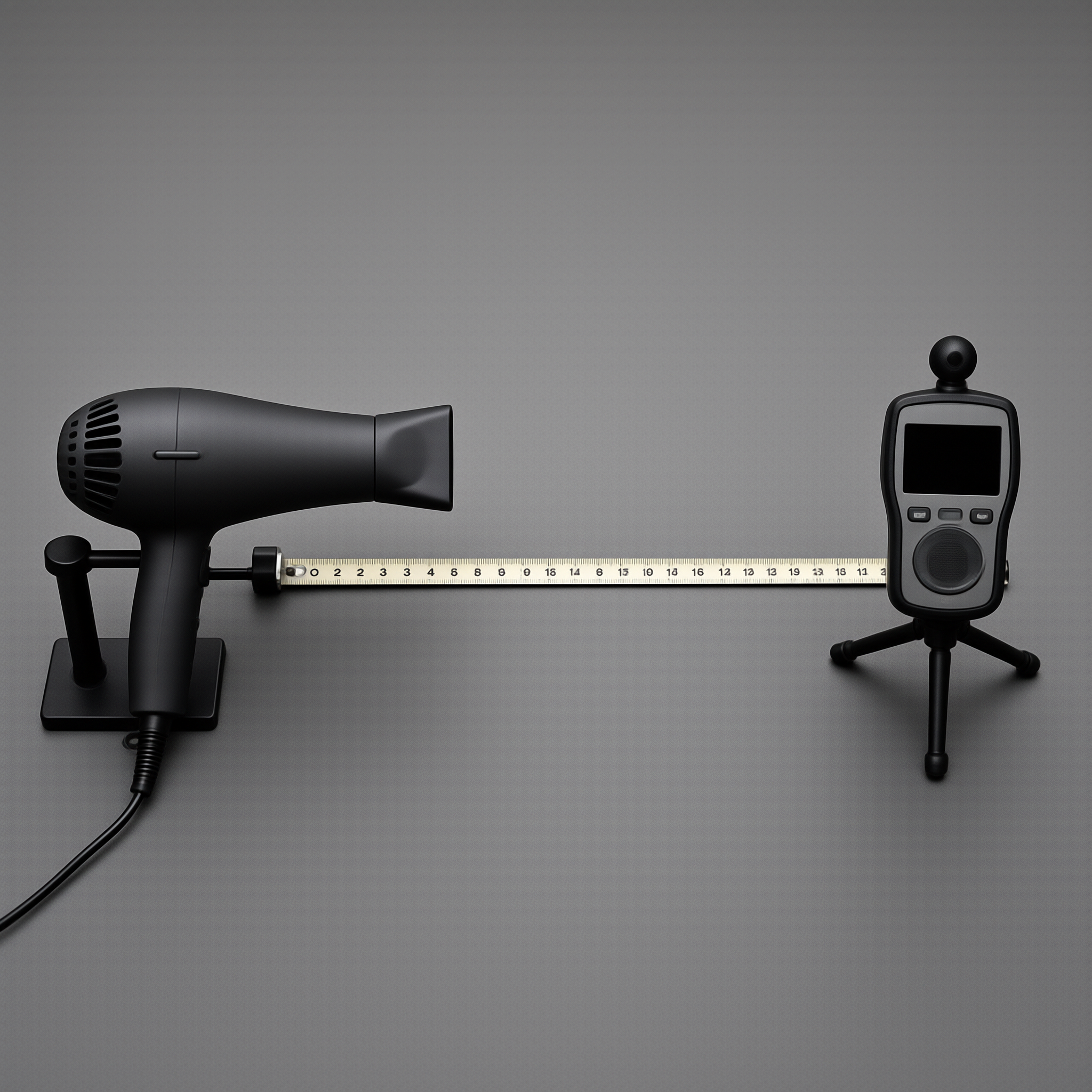
Our factory record for the MY85 states a maximum of 59 dB at 1 metre at full speed, and for the PD01 at or below 70 dB. Both are internal self-test values, not third-party certified. We quote them with the distance and speed attached, because a second dB hair dryer number without those two variables cannot be checked against ours.
Bladeless vs High-Speed Brushless vs Traditional: The Tradeoffs
Each platform wins on a different dimension. A quiet high speed hair dryer is not automatically the lightest or the fastest-drying unit available, and buyers who fix a dB target first usually have to revisit weight and drying performance afterwards.
Traditional AC Motor Dryers (20000-30000 rpm)
Traditional dryers run at 20000-30000 rpm with a brushed motor. The lower speed means a lower blade-pass frequency, which reads as a broad hum rather than a sharp whine. The motor is a known quantity and field-service expectations are well established.
The limitation sits in the motor itself. Brush wear, contact noise and lower airflow per watt are inherent to the design, so this platform trades acoustic character and efficiency against a familiar, serviceable build.
High-Speed Brushless Dryers (110000 rpm)
The PD01 runs at 110000 rpm with 1600W, 465 g and a ceiling of 70 dB at 1 metre at full speed. High rotational speed delivers strong airflow from a small impeller, which is what keeps the unit light.
The tradeoff is tonal rather than purely numerical. At 110000 rpm the blade-pass frequency sits high, so the sound reads as a concentrated whistle instead of a low roar. Buyers testing by ear often describe it as sharper even when the meter disagrees.
Bladeless Designs
The MY85 is 1600W, 544 g, bladeless, with a 59 dB maximum at 1 metre at full speed. Removing the exposed fan face removes the blade-pass tone with it.
Weight is where this platform pays for its quietness. It carries 79 g more than the brushless model at the same 1600W input, and buyers comparing them side by side notice that difference in the hand before they notice the dB gap.
The 59 dB bladeless model weighs 544 g; the 70 dB brushless model weighs 465 g. Quiet and light do not arrive as a set.
How to Write a Noise Specification When Sourcing
Write four things into the specification: distance, speed setting, weighting and the accept/reject rule. If any one is missing, the clause cannot be enforced at inspection. Hair dryer noise level for salon channels is usually the clause buyers most want to tighten.
Measurement distance in metres, written as one figure — 1 m in our records.
Speed setting, stated explicitly — full speed is the only setting we publish.
Weighting, written as dB(A), because A-weighting approximates human hearing sensitivity.
Sample basis: how many units are read, and whether the figure is a maximum or an average.
Test room description and background noise floor at the meter position.
Picture a distributor supplying boutique salons and hotel amenity programmes. They shortlist a traditional-motor unit, the brushless PD01 and the bladeless MY85, then must decide whether a self-test number is defensible in their own catalogue or whether to fund third-party measurement on one or two units during sampling. MOQ at 100 pcs per model keeps that trial small enough to settle before the bulk commitment.
| If your channel needs... | Recommended sourcing path | Why |
|---|---|---|
| A published, defensible noise claim (tender, retail compliance, hotel programme) | Fund third-party measurement inside the sampling round on one or two units | Self-test figures are internal records and are not third-party certified |
| Salon comfort as the primary selling point | Start from the bladeless platform: 59 dB maximum at 1 metre | Lowest ceiling in our range, measured 1 metre at full speed |
| Hand feel and drying speed weighted equally with noise | Start from the brushless PD01: at or below 70 dB, 465 g, 110000 rpm | 79 g lighter than the bladeless model at the same 1600W input |
| A familiar, field-serviceable build | Traditional motor platform, with the acoustic target written by you | No factory ceiling figure is published for that category |
In our sampling programmes, noise disputes at inspection almost always trace back to an approval sheet that stated a dB limit but omitted the distance and the speed setting. We now ask buyers to write both into the approval sheet before the first sample is signed off. It costs one line of text and removes the argument.
FAQ: Noise Questions Buyers Ask
- How loud is a high-speed hair dryer in dB?
- The bladeless MY85 is rated at a maximum of 59 dB at 1 metre at full speed. The high-speed brushless PD01 is rated at or below 70 dB. Both are factory self-test values, not third-party certified, and both require the stated distance and speed setting to be comparable.
- Is 59 dB quiet for a hair dryer?
- It is a lower maximum than the 70 dB ceiling of our brushless model, which makes it the quieter of the two in our range. The figure only carries meaning alongside its measurement distance, speed setting and method.
- Does higher RPM always make a hair dryer louder?
- No. High-speed brushless motors run at 110000 rpm against 20000-30000 rpm for traditional dryers, but RPM mainly shifts tonal frequency. Motor type, impeller geometry, airflow path and housing resonance decide how much of that energy reaches the listener.
- At what distance should hair dryer noise be measured?
- One metre from the unit at full speed. Placing the microphone closer raises the reading, so any dB cap in a purchase order must name both the distance and the speed setting.
- Why do factory noise numbers differ from lab measurements?
- Room reflections, background noise floor, microphone position, mounting method and unit-to-unit variation all move the reading. Factory self-test numbers are internal records and are not third-party certified.
- Can noise be reduced through OEM or ODM development?
- Yes, through four levers: brushless motor selection, impeller redesign, airflow path smoothing and housing damping. Changes must be confirmed on physical samples, and OEM/ODM runs at MOQ 100 pcs per model.
Treat every dB figure as a number with two conditions attached — one metre and full speed. Once those are written into the approval sheet, noise becomes something you inspect rather than something you trust.
About HIGHDRYER
The factory operates from Dongguan, China, established in 2009. It covers 30000 sqm and runs 15 production lines with 300+ staff, at a daily capacity of 20000 units.
MOQ is 100 pcs per model, and OEM/ODM development is available. Certification names we work to include CE, FCC, RoHS, CB, UKCA, ETL and ISO 9001, and export coverage spans multiple countries.
If your channel requires a defensible hair dryer noise level, ask for the record with its measurement conditions travelling in the same line. Distance and speed setting written next to the number keep the comparison honest, whichever supplier you end up buying from.
Factory self-test figures are internal records, not certificates — quote them with their conditions or not at all.