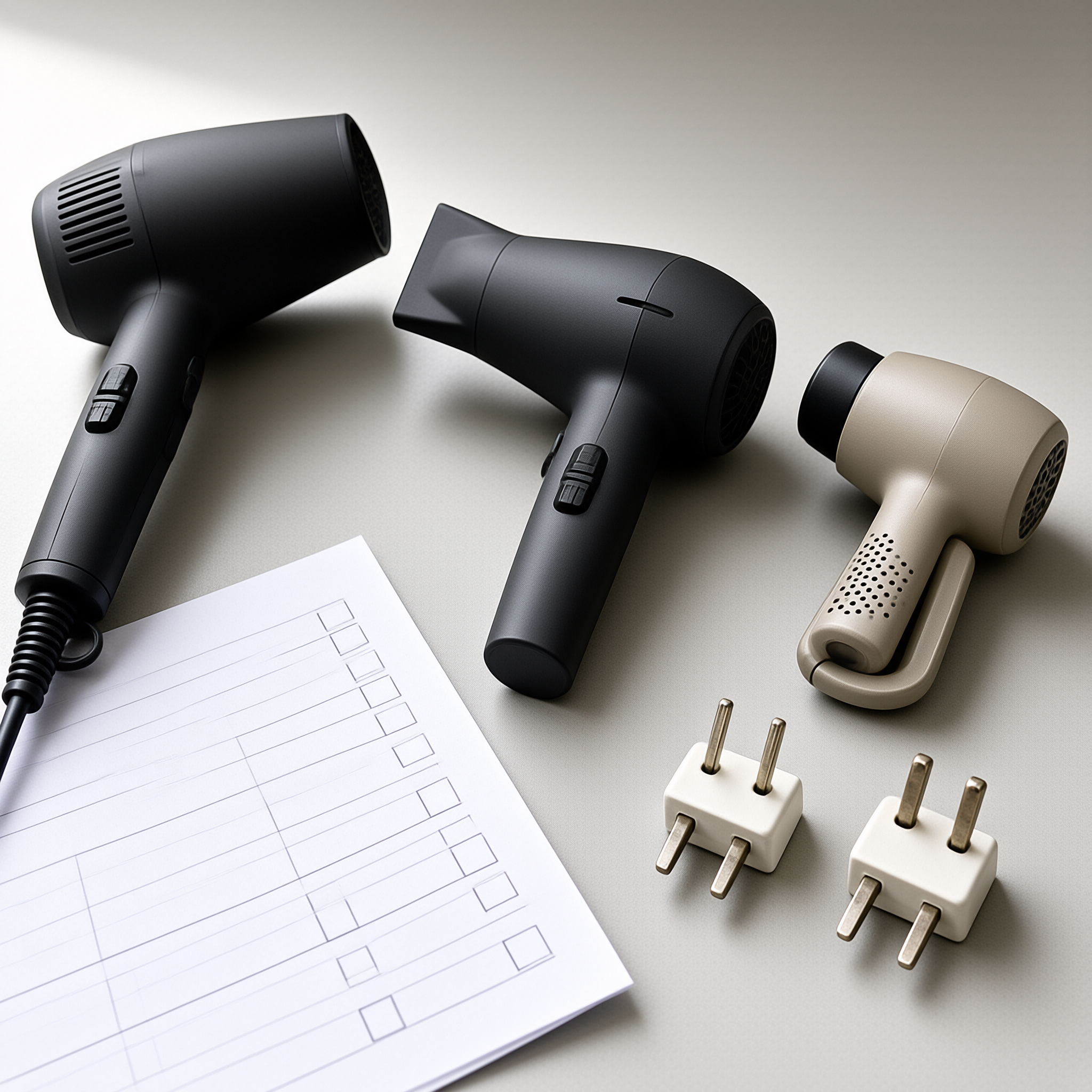
A hair dryer manufacturer B2B buyer checklist only works if every line produces something you can file — a document, a measurement or a physical sample. Before a purchase order is issued, four things must be true: the supplier is the legal entity that builds the unit, the quoted bill of materials matches a sample you have tested, the compliance documents describe that same configuration, and the plug, label and manual already suit your market.
Everything else here is a way of proving those four points. This checklist runs in the order a first order usually fails: identity, then sample, then plug, then paperwork.
A verbal confirmation that a supplier is a factory is not evidence; a business licence scope, a tooling photo and a routine-test record are.
Key Takeaways
MOQ starts from 100 units per model, and models and colours can be combined in one order.
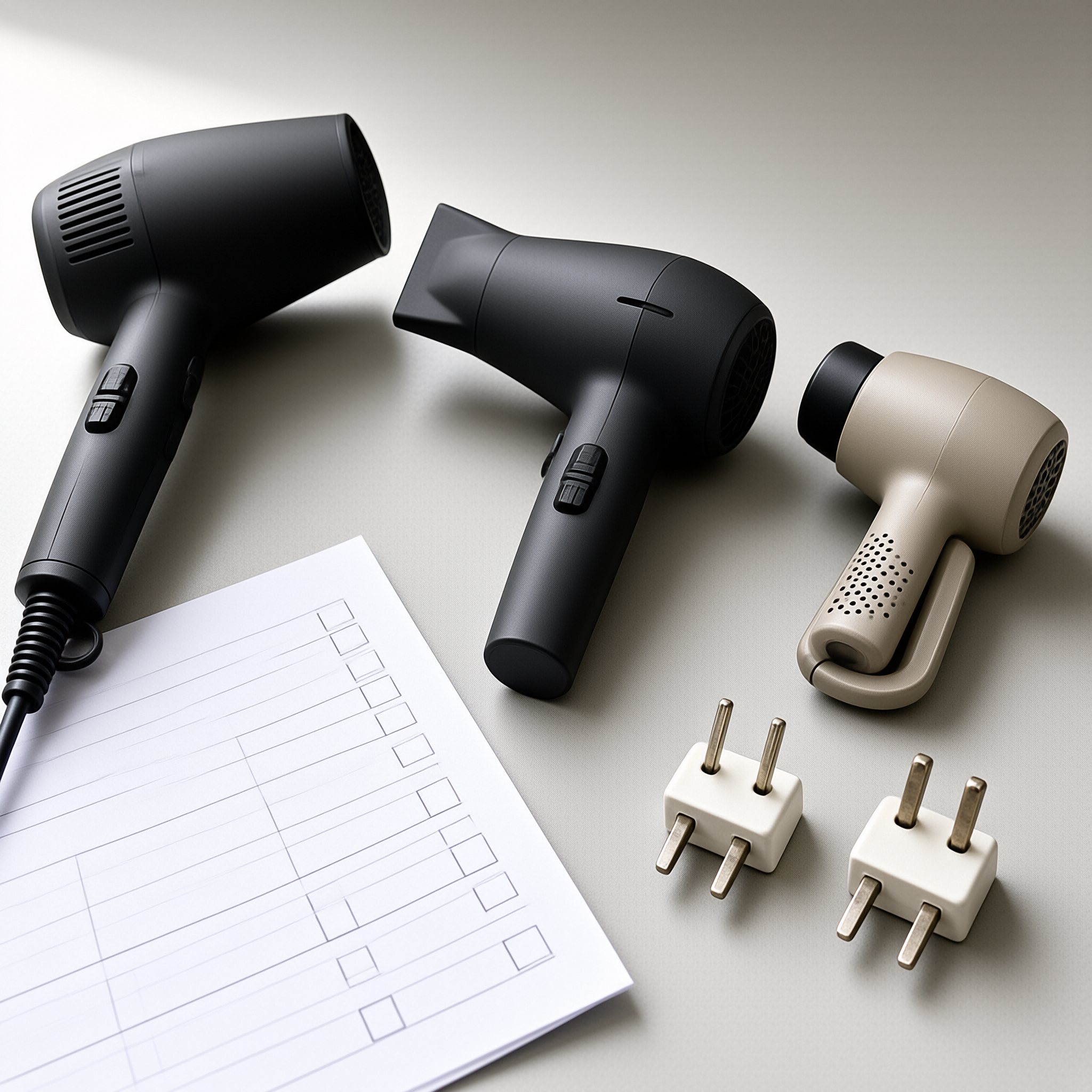
An EU plug hair dryer requires a moulded EN 50075 plug; an adapter leaves the appliance non-conforming.
A certificate is evidence only when it names the configuration you are actually buying.
Samples typically ship in 7 days; bulk production runs 25-35 days after sample and artwork approval.
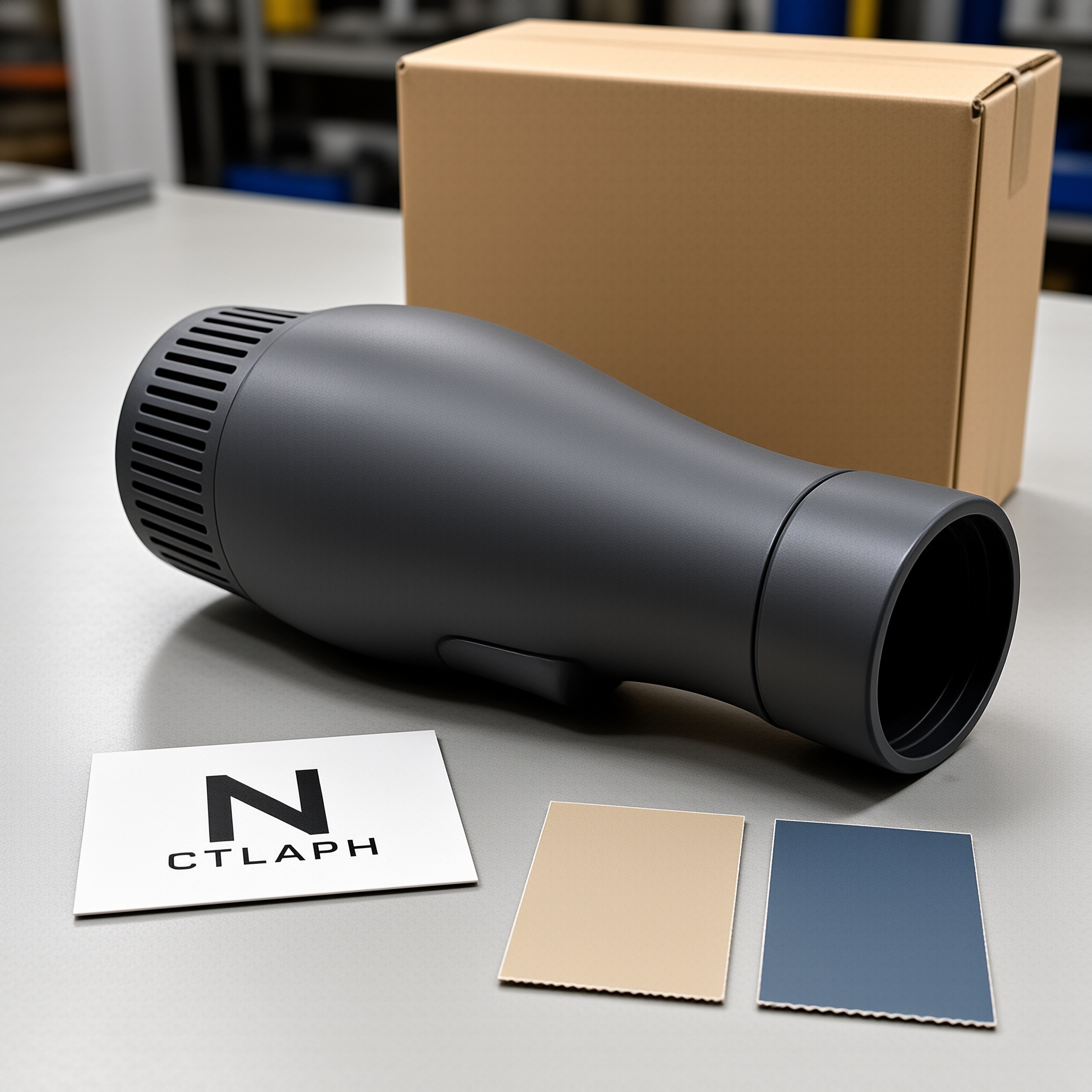
Specify shell colour as a ΔE ≤1.5 tolerance against a signed master when one order mixes models and colours.
What 'Evidence Before PO' Actually Means for a Hair Dryer Order
Evidence before PO means every claim on a quotation is backed by a document you keep, a measurement you take, or a sample you hold. Anything that exists only as a verbal assurance is not evidence.
A purchase order converts promises into obligations, so proof has to move to the buyer's side before signature. Documents survive staff changes and factory switches; assurances do not. Building the file before payment also exposes gaps early, while they are still cheap to fix.
Treat it as four evidence classes and check each at quotation stage. The legal entity comes from the business registry. The sample is signed against a bill of materials. Compliance documents must name the configuration. The fourth class is the market set: plug, rating label and manual language.
Factory or Trading Company: The Evidence That Tells Them Apart
A trading company can supply a perfectly good hair dryer, but only a manufacturer can show the tooling, the line and the QC records behind it. If in-house production is what the price is meant to buy, ask for evidence only a factory can produce.
The difference is where manufacturing control sits. A trader's business licence scope usually lists wholesale or trade, and technical answers route through someone else. Production evidence — mould ownership, assembly stations, routine-test equipment — exists only where units are actually built. That gap separates the two faster than price does.
Ask who owns the housing tooling, then request a photograph of the mould with the model identified on it. Ask two technical questions — motor specification and heater wattage tolerance — and note whether the reply carries parameters or a promise to check. Finally, match the business licence scope to the goods.
| Dimension | Direct manufacturer | Trading company |
|---|---|---|
| Business licence scope | Manufacture of household electrical appliances | Trade, wholesale or import-export |
| Housing tooling | Owned and maintained in-house | Owned by a third-party factory |
| Technical answers | Parameters from the production team | Relayed, often with delay |
| QC records | Produced on the line being quoted | Forwarded from another site |
| Change control | Buyer-approved sample stays with the tool | Depends on the upstream factory |
| Sample source | Built on the quoted line | Pulled from stock or a partner |
Hair Dryer Manufacturer in China: How to Shortlist and Verify Capacity
Shortlisting a hair dryer manufacturer in China is a two-stage job: verify the legal entity, then verify that the quoted capacity is genuinely free in your window. Neither stage needs a factory visit if you request the right documents.
Capacity claims usually fail for scheduling reasons rather than dishonesty. A line running seasonal orders has idle hours, not idle weeks, so a new model must be slotted into an existing changeover rhythm. The changeover calendar predicts delivery risk better than a monthly total.
Request the business licence, the production schedule for the next two months, and the entity name that will appear on the certificate of origin. Cross-check scope against goods, and schedule against your launch date. If the three do not line up, you have a price, not a plan.
Business Licence Scope and Legal Entity
Read the scope line first. It should list manufacture of household electrical appliances, not only trade or import-export.
Then match the unified social credit code against the bank account name on the proforma invoice. A mismatch between licence, contract and payment beneficiary is a payment-risk signal, not a paperwork detail.
Capacity Questions That Expose Real Output
Daily capacity means little without lines and shift pattern behind it. Ask how many assembly lines run the model family, how many units per line per shift, and how many changeovers a week the line takes.
Then ask what else is booked on those lines during your window. A supplier that answers with a schedule is planning; one that answers with a total is marketing. Write delivery as working days after sample approval.
Export Documentation Trail
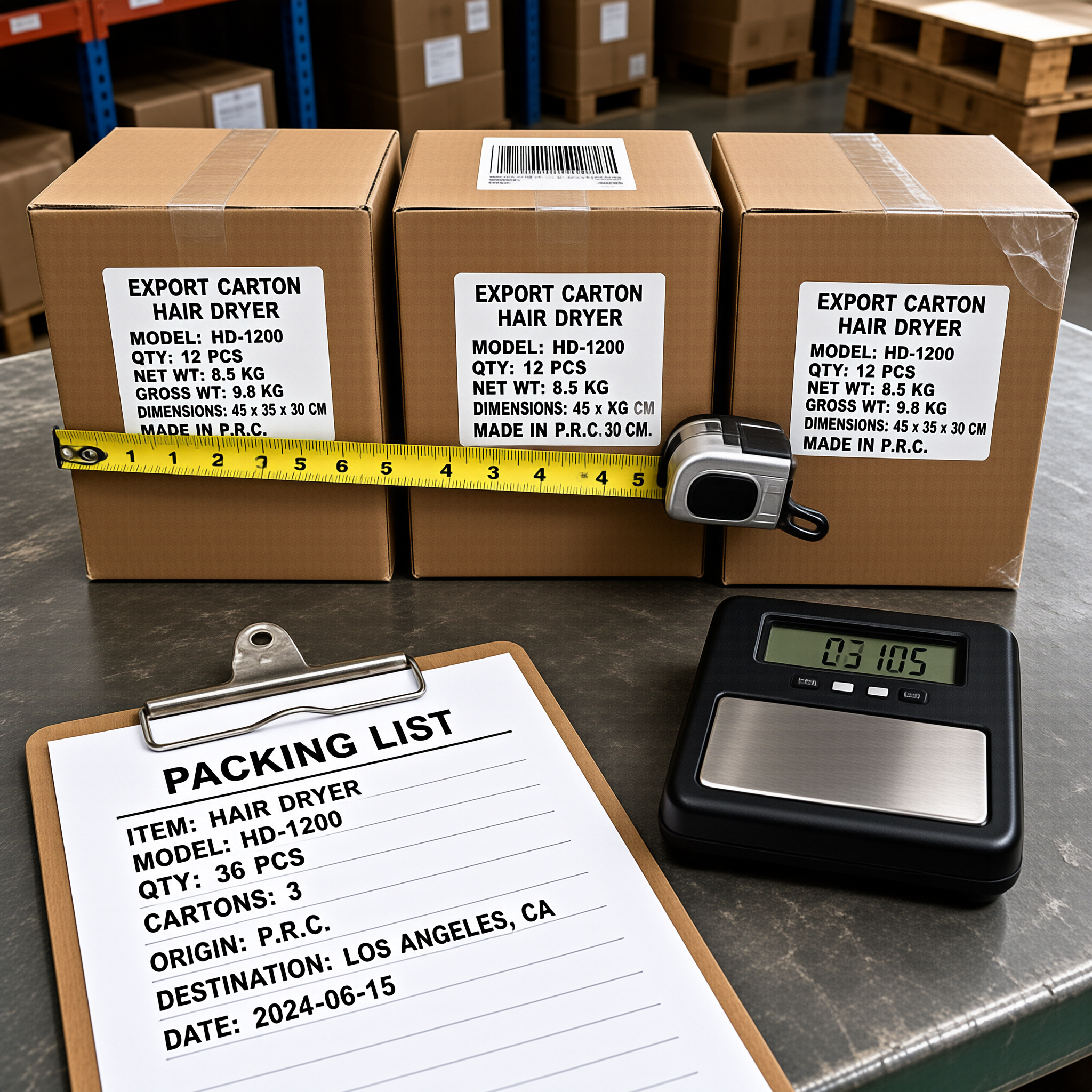
The trail must agree across quotation, proforma invoice, packing list and certificate of origin. Same entity, same address, same product description.
Ask which documents travel with the shipment and who prepares them. Under L/C terms this becomes critical, because one inconsistent description turns into a discrepancy fee at the bank.
A supplier that answers a capacity question with a schedule is planning; one that answers with a monthly total is marketing.
EU Plug Hair Dryer vs Other Plug Configurations: What Changes on the Line
An EU plug hair dryer differs from other configurations in four places: the moulded plug, the cord set, the rating label and the manual language. The appliance does not change; the market package around it does.
EN 50075 (CEE 7/16) defines the Europlug as a moulded Class II plug with fixed pin geometry and marking. Because it is injection-formed onto the cord, plug and anchorage form one assembly, which is what makes pull and torque testing meaningful. A clip-on adapter leaves the original plug and cord set unaltered, and therefore unverified for that market.
Incoming cord-set inspection should verify pin dimensions and marking against EN 50075 go/no-go gauges, confirm the plug is moulded rather than fitted, and check cord anchorage by the pull and torque method in IEC 60335-1. Also review EU Safety Gate recall alerts for withdrawals involving the model or plug design before you commit.
| Requirement | EU (CEE 7/16) | UK plug | US plug |
|---|---|---|---|
| Plug construction | Moulded, two-pin, Class II | Moulded, three-pin, fused | Moulded, two-pin, ungrounded |
| Mains rating | 230 V / 50 Hz | 230 V / 50 Hz | 120 V / 60 Hz |
| Marking | CE marking plus rated voltage | UKCA marking plus fuse rating | Local rating plate rules |
| Manual language | Language of the destination market | English | English, plus local language where required |
| Cord set | Moulded Europlug on flexible cord | Fused plug, heavier cord | Polarised or non-polarised plug |
Moulded EN 50075 plug, never an adapter fitted at the warehouse.
Cord length and anchorage specification written into the PO.
Manual in the language of the destination market.
CE documentation matched to the shipped build.
Rating label showing the destination voltage and frequency.
Failure Modes Buyers Only Discover After the PO Lands
Post-delivery hair dryer failures cluster in four places: cord anchorage, thermal cut-out calibration, switch contact wear and heater element variation between lots. A sample that passed inspection cannot reveal any of them.
Cord failures start at the anchorage, not the copper. The strain relief takes the pull every time the dryer is unplugged, so a loose clamp lets conductors fatigue inside the sheath. Cut-out drift happens when the cut-out sits further from the heater than the evaluated build assumed, so it trips late — or not at all.
Write the checks into the PO instead of hoping for them: a cord anchorage pull and torque test per IEC 60335-1, a heat-cycle run through every setting with the inlet partly blocked, and a heater wattage measurement on the shipping lot. Each check targets one failure mode, not the product in general.
Dryer cuts out after a few minutes → cut-out sits too far from the element → verify the trip point on the shipping lot.
Cord sheath splits near the plug → anchorage clamp too loose → pull and torque test per IEC 60335-1.
Switch feels soft or intermittently dead → contact rating below element current → specify rating against measured current.
Heat output drifts between shipments → element tolerance too wide → set a wattage band in the PO.
Plug warm in use → high contact resistance at the pin → check pin material and pin gauge.
Sampling Cost, MOQ and Landed Cost: The Numbers Behind the Checklist
Minimum order quantity starts from 100 units per model, and models and colours can be combined in one order. Housing or airflow modification and fully bespoke development carry higher, tooling-dependent minimums.
Setup cost is fixed per run — mould trials, colour changeover, packaging plates, manual layout — so a 100-unit run absorbs the same setup as a run twenty times its size. Per-unit price therefore falls steeply at the start of the volume curve. The cheapest unit price and the cheapest first order are rarely the same quotation.
A European distributor launching two SKUs for a retail chain, ordering 100 units per model with colours split across both, has three quotations, one sample and a fixed launch date. That is the moment landed cost beats FOB. For any custom hair dryer OEM ODM order, put colour in writing as ΔE ≤1.5 under D65 against a signed master sample, or adjacent models in one shipment will visibly differ at retail.
| Your situation | Recommended configuration |
|---|---|
| Fixed launch budget, unproven market | Choose stock colours, 100 units per model, and spend the difference on pre-shipment inspection |
| Colour is the brand differentiator | Choose custom colour with ΔE ≤1.5 to a signed master, and accept a higher first-order unit cost |
| New airflow or housing design | Higher, tooling-dependent minimum — plan a longer tooling timeline before confirming the launch date |
| Launch across several markets | Choose separate plug and cord-set SKUs, with one manual per language |
Certifications: Which Documents Are Evidence and Which Are Just Copies
A certificate is evidence only when it names the model and configuration you are buying. A document describing a different build is a copy, not proof.
Household hair dryers are covered by IEC 60335-2-23, which applies on top of the general IEC 60335-1. A test report describes the specific build evaluated — motor, heater wattage, cord set, enclosure — so changing any of those moves the product outside the document. ISO standards draw a similar line: ISO 9001 certifies how quality processes are run, not how an individual dryer performs.
Ask three questions of every document: which model and configuration it covers, whether that configuration matches your BOM, and what happens if the production build differs. The names to request are CE, FCC, RoHS, CB, UKCA, ETL and ISO 9001 — each matched to the shipped build, not filed as a badge.
ISO 9001 certifies how a factory runs quality processes; it does not certify the performance of the dryer you are buying.
Sample Inspection: Red Flags in Motor, Heater, Cord Set and Switch
A sample inspection should end with a signed sample and a written list of what would make you reject a production unit. Hair dryer sample approval without that list is an opinion.
Samples are usually built on the best line, sometimes by hand, so they prove design intent rather than production consistency. Judging the sample against a specification document is what makes it comparable to later shipments.
Record airflow at each speed, outlet temperature, wattage draw and cord length, and attach the readings to the signed sample. Those readings become the acceptance criteria in the PO. For production, request the routine-test record sheet, not just the type-test report: the IEC 60335-1 routine structure expects 100% of units to pass a dielectric strength (hi-pot) test, an earth continuity check where the design requires it, and a functional run through every speed and heat setting.
Motor, Airflow and Noise
Listen at every speed and check that pitch changes with the setting rather than staying flat. A flat tone across speeds often means one motor regulated by voltage drop, which shortens motor life.
Measure airflow at the nozzle on each setting and compare it with quoted wattage. High wattage with weak airflow points to an undersized fan or a restricted inlet path.
Heater Element and Thermal Cut-Out
Run the dryer at full heat with the inlet partly covered and time how long the cut-out takes to trip. A cut-out that never trips is a safety failure, not a feature.
Check outlet temperature at each heat setting and note the swing between them. Then confirm element wattage against the label — a mismatch exposes a substituted heater.
Cord Set, Plug and Switch Gear
Flex the cord at the anchorage and watch for movement inside the housing. A plug that is moulded, marked and dimensionally correct is the only acceptable EU configuration.
Press each switch through its full travel and look for positive detents and no rocker play. Then confirm the switch rating against measured current, not the rated current printed on the label.
Frequently Asked Questions
- What is the minimum order quantity for a custom hair dryer?
- From 100 units per model, and models and colours can be combined in one order. Housing or airflow modification and fully bespoke development carry higher, tooling-dependent minimums.
- Do I need different certification for an EU plug hair dryer?
- The names stay the same — CE, RoHS, and CB where applicable — but the plug, cord set, rating label and manual language must match the configuration that was evaluated.
- How long does sampling and bulk production take?
- Samples typically ship in 7 days, and bulk production runs 25-35 days after sample and artwork approval. Colour approval rounds consume calendar time before the line starts.
- Can a supplier's certificate be used as proof of quality?
- No. A certificate documents conformity of a tested configuration, so it proves your goods only when the BOM matches that configuration and pre-shipment inspection confirms it.
- What payment terms are normal for a first order?
- T/T, L/C and Western Union are common. Balance deposit size against inspection rights: a larger deposit with pre-shipment inspection access is usually safer than a small deposit with none.
- What should be written into the purchase order?
- Acceptance criteria for function, hi-pot and appearance, the plug and label specification, the packaging artwork revision, and the remedy if units fail inspection.
The value of a hair dryer manufacturer B2B buyer checklist is not the list itself but the file it produces: licence, signed sample, BOM, test report, plug specification and inspection terms. Build that file before the PO, and every later dispute becomes a comparison against a document rather than a conversation.
Every post-delivery dispute is either a comparison against a document or an argument you cannot win.
About highdryer
highdryer is a high-speed hair dryer manufacturer based in Dongguan, China, established in 2009. Our 30,000 sqm facility runs 15 production lines with 300+ staff and a daily capacity of 20,000 units. We support OEM/ODM with logo, colour, packaging and manual customization. MOQ starts from 100 units per model, and models and colours can be combined in one order. Samples ship in 7 days; bulk lead time is 25-35 days. Payment terms: T/T, L/C, Western Union. Certifications: CE, FCC, RoHS, CB, UKCA, ETL, ISO 9001. Contact us for a quotation against your specification.