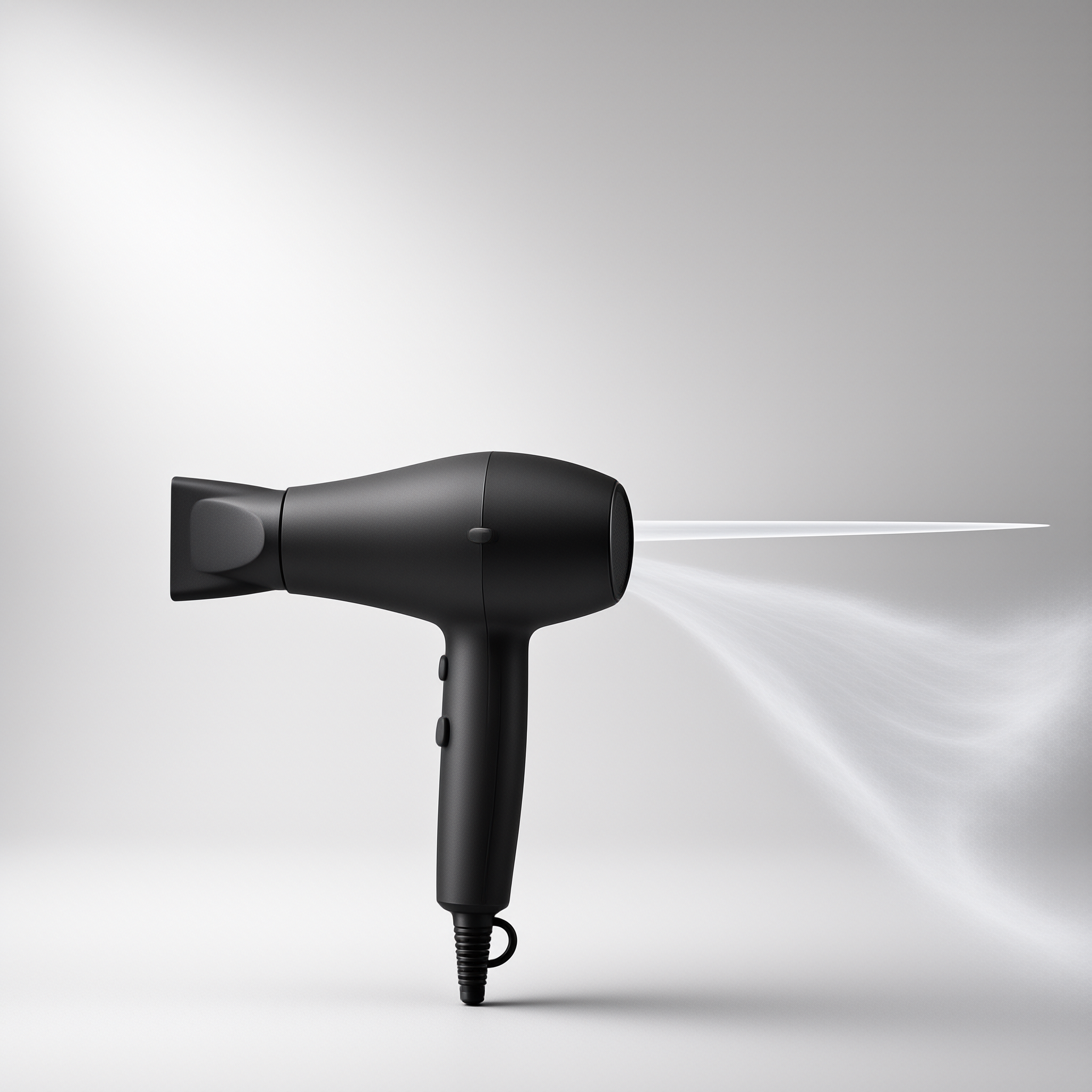
An importer listing one hair dryer SKU across several markets meets the voltage question on the first order. The unit that works in Texas is not the unit that works in Berlin, and the mismatch comes back as failed units, refunds and dead stock.
Definition
What is a dual voltage hair dryer? It is a hair dryer designed to run on both the 110V class and the 220-240V class of mains supply, either through a manual voltage selector switch or a wide-range power driver.
Two mains voltage classes divide the global market, and a dryer built for one will not perform correctly on the other.
Dual voltage lets an exporter serve both classes without holding two separate SKUs per model and colour.
A selector switch and a wide-range driver solve the same problem in different ways, with different cost and user-error profiles.
Dual voltage does not make the plug universal; the cord set and plug type still have to match the destination socket.
Mains frequency, 50Hz or 60Hz, is a separate variable affecting motor speed and heater behaviour.
Wrong-voltage returns usually cost more than the gap between single-voltage and dual-voltage stock.
How the 110V and 220-240V Split Shapes Export Planning
Mains voltage is an installation fact, not a buyer preference. The 110V class covers the United States, Canada, Mexico, Japan at 100V, Taiwan and parts of South America. The 220-240V class covers Europe, Russia, Kazakhstan, the Middle East, Africa, most of Asia and Australia.
A dryer designed for 220-240V running on a 110V supply will spin slowly, deliver weak airflow and may never reach working temperature. The reverse combination is worse: a 110V unit connected to a 230V socket is a safety event, not a performance complaint.
The split is not about quality or price tier. A 220-240V market is not a premium market and a 110V market is not a discount market; both buy the same motor, the same housing and the same finish. The only difference is the power path inside the barrel.
Buyers selling into several regions usually discover this late. Country-by-country plug and socket references are published by IEC World Plugs, and it is worth mapping your target markets against that reference before the purchase order rather than after the first returns.
The Commercial Problem: One SKU Across Two Voltage Bands
The commercial problem is inventory shape. A single-voltage catalogue forces you to hold one variant for 110V markets and another for 220-240V markets, across every model and every housing colour. Safety stock doubles, and slow-moving colours get stranded in the wrong region.
The second cost is returns. Wrong-voltage use rarely looks like user error on arrival; it looks like a dead unit. You absorb the replacement, the outbound freight, the return freight and the review score. On marketplace listings, that damage does not wash out.
There is also a cash argument. Two SKUs mean two purchases, two sets of carton artwork and two container plans. One dual voltage build with a market-specific cord set keeps the purchase order simple and keeps artwork spend in a single place.
A dual voltage version collapses the two lines into one. You buy one model, choose from 12+ housing colours, ship the same carton to either region, and the only market-specific item left is the cord set. That is a far smaller inventory decision than a second SKU.
Region, Voltage, Plug and Frequency at a Glance
The table below is the practical version of the voltage map. Read plug type and frequency as separate columns, because they are separate engineering decisions that get specified at different stages.
| Market | Voltage class | Common plug types | Frequency |
|---|---|---|---|
| United States, Canada, Mexico | 110-120V | A, B | 60 Hz |
| Japan | 100V | A, B | 50 Hz east / 60 Hz west |
| Taiwan | 110V | A, B | 60 Hz |
| Brazil, Chile, Argentina | 110-127V and 220V | A, B, C, I | 50 Hz / 60 Hz |
| European Union, EFTA | 220-240V | C, F (G in the UK and Ireland) | 50 Hz |
| Russia, Kazakhstan | 220-240V | C, F | 50 Hz |
| Gulf states, Middle East | 220-240V | G, with C and F in parts | 50 Hz |
| Nigeria, Ghana | 220-240V | G, with D and M in parts | 50 Hz |
| India, South Africa | 220-240V | D, M (C in South Africa) | 50 Hz |
| Australia, New Zealand | 220-240V | I | 50 Hz |
| China | 220V | I, A, C | 50 Hz |
Read the table as three independent columns. Voltage decides whether the dryer runs correctly. Plug type decides whether it plugs in at all. Frequency decides how the motor and heater behave once it is running. All three belong in the purchase specification, not in a follow-up email.
Selector Switch or Wide-Range Driver
There are two ways to build a dual voltage dryer. The first is a selector switch: two windings or two taps, and a mechanical switch the user sets to 110V or 220-240V. It is the cheaper route and consumers in dual-voltage households already understand it.
The weakness is user error. Someone who forgets to move the switch gets the failure the switch was meant to prevent. Labelling reduces the risk; it does not remove it. For markets where the end user has never thought about voltage, that matters commercially.
The second route is a wide-range driver that accepts the full 100-240V band automatically, with no user action at all. Unit cost is higher and the electronics have to be specified properly, but the failure mode disappears. Our dual voltage versions ship as 110V and 220-240V builds with a 110,000 rpm brushless motor, air speed up to 23 m/s and noise at or below 70 dB.
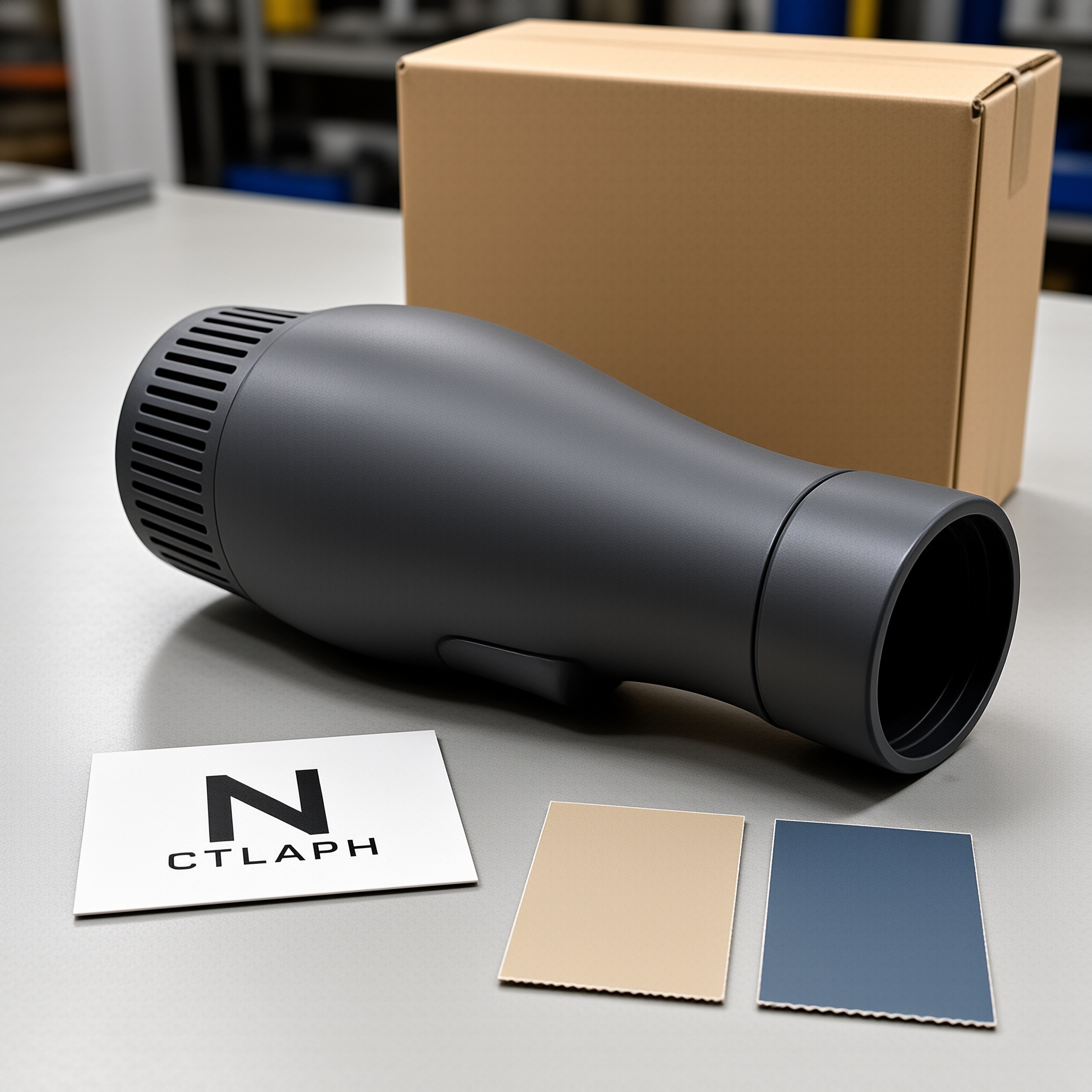
Housing tooling is ours. Moulds S01, S02 and PD01 are private tooling and are not carried by other suppliers, which is why the body shape, the fit of the parts and the colour range stay consistent across repeat orders.
Plugs, Cords and What Dual Voltage Does Not Cover
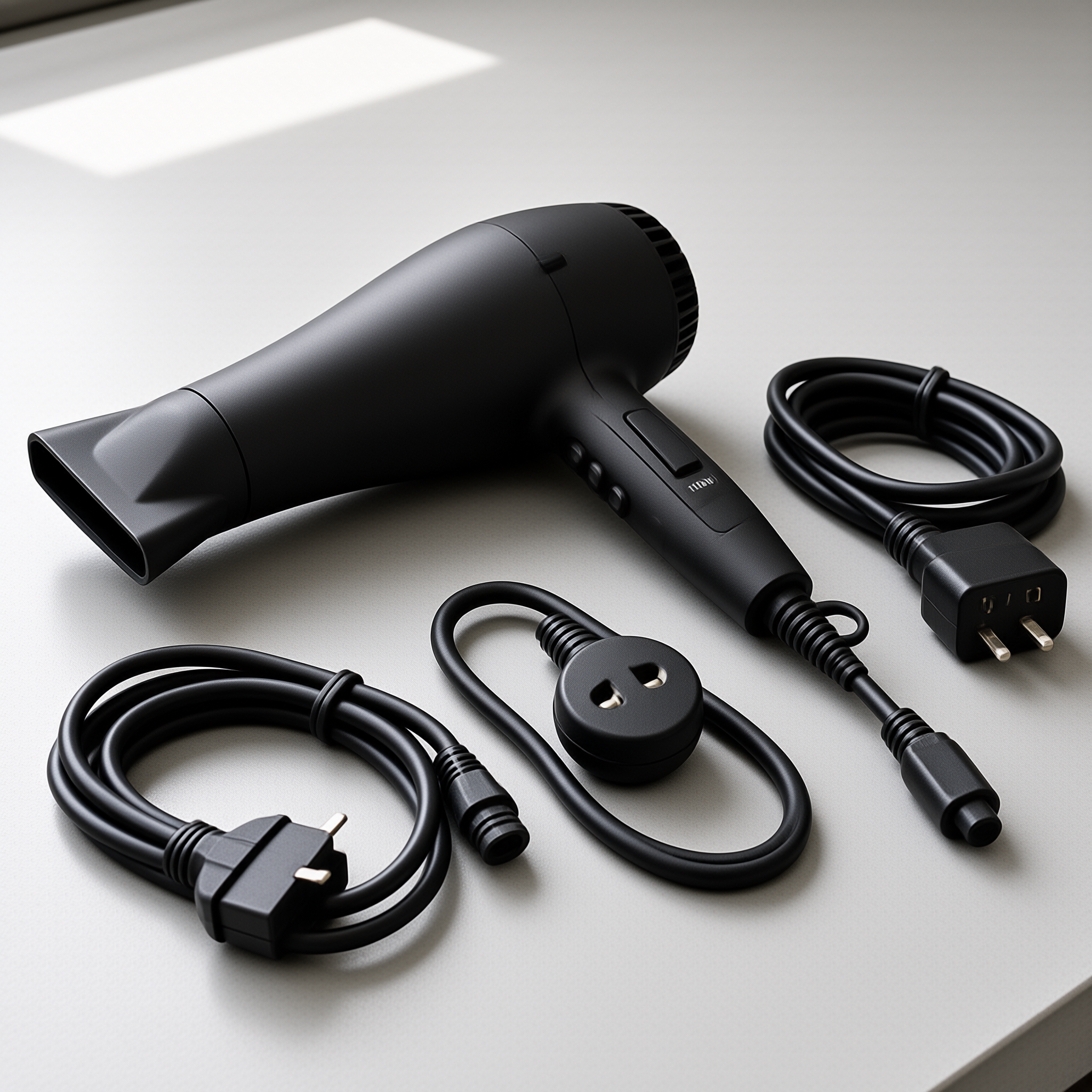
Dual voltage does not make the plug universal, and a supplier who implies otherwise is handing you a returns problem. The cord set covers the socket. Plug types split broadly as A and B in North America, C and F in Europe, G in the UK, the Gulf and Nigeria, I in Australia and China, and D and M in India and South Africa.
The practical answer for exporters is a detachable cord set or a market-specific fixed cord, decided at order stage. Confirm the certification scope for each destination build as well. CE, FCC, RoHS, CB, UKCA and ETL are the usual set, and each build is its own approval conversation.
Do not treat a travel adapter as the design solution. An adapter fixes the socket, not the supply, and it adds a component the buyer did not ask for, cannot certify and will blame you for when it is lost.
Frequency: The Variable Buyers Forget
Frequency is the line that gets left off the specification sheet. A 50Hz supply and a 60Hz supply drive conventional AC motors at different speeds, so a dryer tuned on one can run fast or slow on the other. Heater behaviour and control timing shift with it.
This is not theoretical. A unit that heats correctly on a 60Hz test bench can feel different on a 50Hz supply, and the complaint gets attributed to the product rather than to the test setup. Put the target frequency in the test brief before the first sample is built.
A brushless motor with its own driver is less exposed to mains frequency than a conventional AC motor, because the driver sets commutation rather than the mains. The heater element and the control board still reference the supply, so frequency remains part of the brief.
If your engineers want background material, arXiv indexes the driver-side literature and Semantic Scholar covers conventional motor behaviour. Google Scholar is the faster entry point for voltage compatibility work across appliance categories.
Specifying Dual-Voltage Stock for Your Market
Step 1: Map every target market to three columns — voltage class, plug type and frequency — before you talk to any factory.
Step 2: Decide whether your market can be trusted with a selector switch or needs an automatic wide-range driver.
Step 3: Fix the cord set and plug type per destination, and decide whether detachable gives you more flexibility than fixed.
Step 4: Confirm the certification scope each destination build actually requires.
Step 5: Order samples in the exact voltage variant you intend to sell, not a near equivalent.
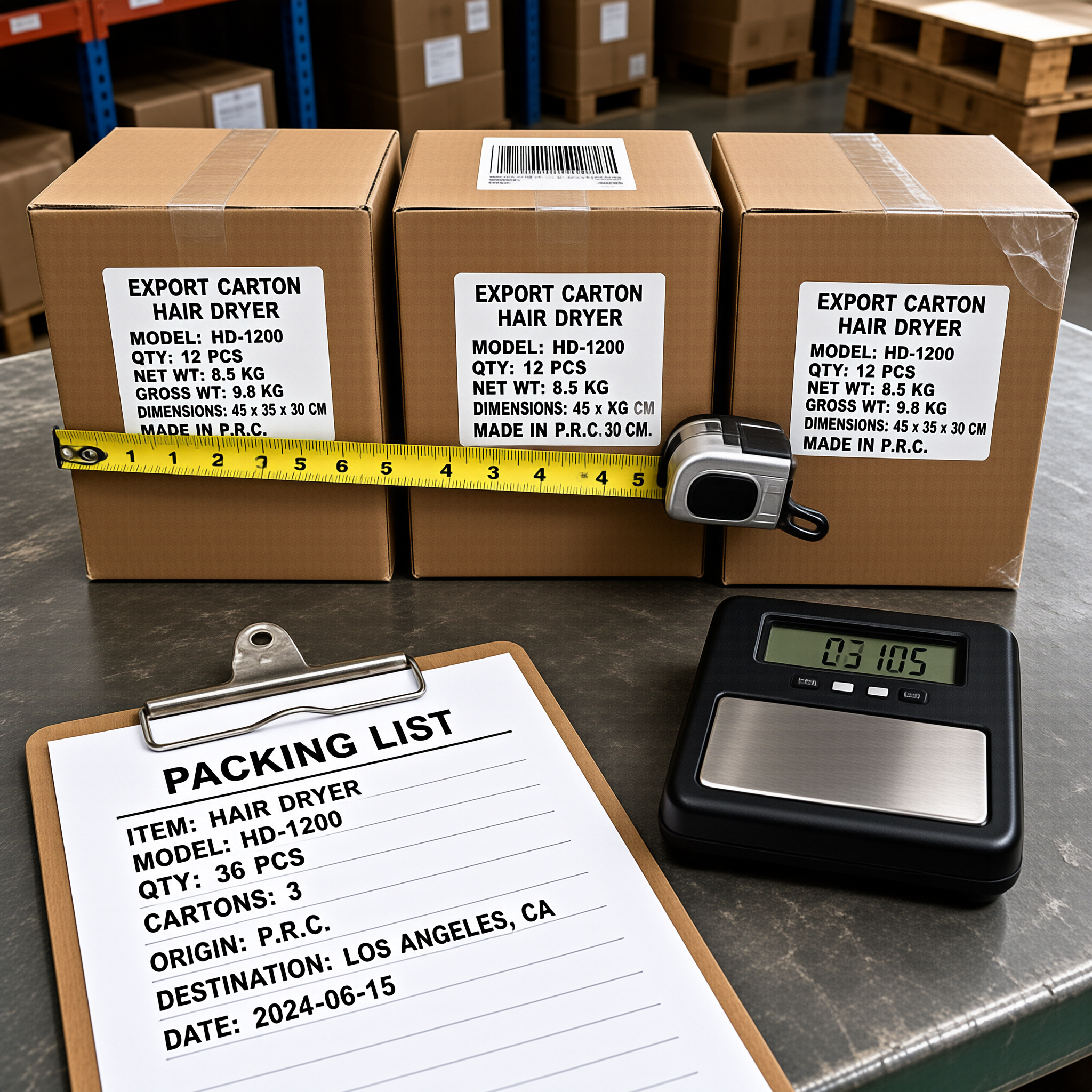
Step 6: Approve carton artwork early, because custom colour boxes carry their own minimum quantity.
Step 7: Lock the bulk schedule after deposit and artwork approval, then plan freight around that date.
On volume, our factory MOQ is from 100 units per model, and models and colours can be combined in one order, so a first run does not have to be a single-variant bet. Logo printing on the product carries a small per-unit charge below 1,000 pcs per model and is free at 1,000 pcs and above; custom colour boxes start at 2,000 boxes.
Samples take 7 days. Bulk runs take 25-35 days after deposit and artwork approval. Payment is by T/T, L/C or Western Union. Every unit is inspected before dispatch rather than sampled, and the warranty runs 12 months against manufacturing defects.
Frequently Asked Questions
- What is dual voltage on a hair dryer?
- Dual voltage means the dryer can run on both the 110V class and the 220-240V class of mains supply. It is achieved either with a selector switch or with a wide-range driver that accepts both bands automatically. It is a supply decision, not a plug decision.
- Why does a 220V hair dryer run slow on 110V mains?
- The motor and heater receive roughly half the voltage they were built for, so airflow drops and the element struggles to reach working temperature. It is not a fault in the unit; it is the wrong build for that socket. The reverse combination, a 110V unit on 230V, is a safety risk rather than a performance complaint.
- How to choose between a selector switch and a wide-range driver?
- Choose the selector switch when unit cost is the priority and the end user understands voltage switching. Choose the wide-range driver when the product will be used by people who will not read the label. The driver costs more per unit and removes the failure mode entirely.
- Does dual voltage mean the plug works in any country?
- No. Dual voltage covers the supply; the plug and cord set cover the socket. A dual voltage dryer with a type A plug will not fit a type G socket without an adapter or a different cord set, so plug type is specified separately for each market.
- What are the main 110V and 220-240V markets for hair dryer export?
- The 110V class covers the United States, Canada, Mexico, Japan at 100V, Taiwan and parts of South America. The 220-240V class covers Europe, Russia, Kazakhstan, the Middle East, Africa, most of Asia and Australia.
- What is the minimum order quantity for dual voltage models?
- Our factory MOQ is from 100 units per model, and models and colours can be combined within one order. That lets a first run test several markets without committing to a single variant.
- How long do samples and bulk production take?
- Samples are ready in 7 days. Bulk production runs 25-35 days after deposit and artwork approval. Both timelines assume the voltage variant and the cord set were confirmed at the sample stage.
About highdryer
highdryer is a hair dryer and hair styling appliance manufacturer based in Dongguan, Guangdong, China, established in 2009. The factory covers 30,000 sqm with 15 production lines, 300+ staff and a daily capacity of 20,000 units. Every unit is inspected before dispatch rather than sampled, and the factory holds ISO 9001. Importers and brand owners are welcome to get in touch for specifications, samples or a quotation on dual voltage builds.
Sam | WhatsApp +86 159 7657 8889 | highdryer@highdryer.com | www.highdryer.com