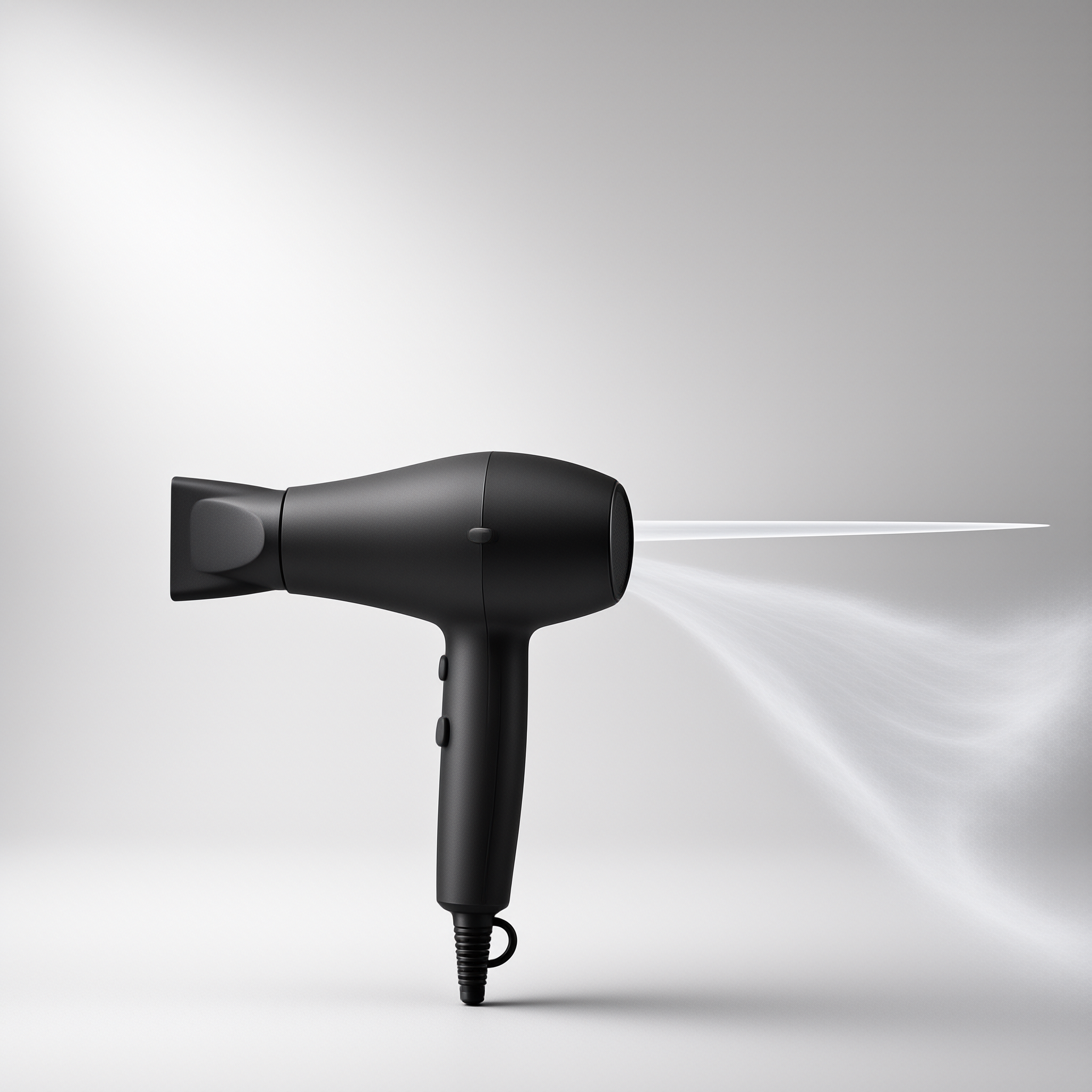
A hair dryer running at 105,000 RPM and one running at 25,000 RPM are not the same product on different settings. The motor decides how much air reaches the hair, how loud the unit is in a hotel bathroom, and — the part that shows up in your warranty claims — how long the appliance keeps working after the first year.
Definition
A high-speed hair dryer motor is the fan-driving component that generates airflow; brushed motors commutate through carbon brushes sliding on a rotating contact, while brushless motors switch current electronically with no physical contact between moving parts.
Key Takeaways
Brushless motors run at 100,000–110,000 RPM; conventional brushed motors typically reach 20,000–30,000 RPM.
Brushed motors wear at the brush-commutator interface by design; brushless motors have no sliding contact, so wear moves to bearings and the controller.
For the same output a brushless motor is lighter, which helps hold finished dryer weight between 383 g and 520 g depending on model.
High-speed designs reach airflow of around 23 m/s, and noise under 70 dB is achievable at full speed with a well-matched impeller and duct.
Motor choice splits a range: brushed for entry price points, brushless for premium SKUs that carry longer warranty terms.
Why motor type decides how long a dryer lasts
A brushed motor fails in a predictable order. The carbon brushes shorten as they run, carbon dust settles on the commutator, contact resistance climbs, and the motor draws more current to hold its speed. The user experiences this as a dryer that gradually feels weaker and hotter before it stops entirely.
A brushless motor has no consumable sliding contact. Wear concentrates in the bearings, the rotor balance and the power electronics on the controller — parts that degrade with heat and dust rather than with friction. That shifts the service profile from replacing a wear part to protecting the electronics and keeping the airflow path clean.
Brushless vs brushed: where the wear actually happens
Both motor types do the same job: spin an impeller fast enough to push air through the barrel. The mechanical route they take to that job is completely different, and that route is what determines the failure mode your after-sales team will eventually handle.
How carbon brushes wear down
Brushes are spring-loaded carbon blocks pressed against a segmented commutator. Every rotation scrapes a small amount of material from both surfaces, and the residue has to go somewhere — usually into the motor housing and the airstream. This is mechanical wear by design; build quality can slow it, but it cannot remove it. Published work on Semantic Scholar - electrical brush wear and commutator studies covers how contact pressure and current density affect brush life.
Why electronic commutation changes the wear equation
A brushless motor replaces the commutator with a controller that switches current through the stator windings in sequence, using rotor position feedback. Nothing rubs, so the dominant failure modes become thermal and electrical: capacitor ageing, switching stress on the power devices, and bearing lubrication drying out under heat. Bearing selection and thermal design become the variables that control longevity; general reliability research is indexed under Google Scholar - brushless DC motor bearing and reliability research.
| Feature | Brushed motor | Brushless motor |
|---|---|---|
| Typical rated speed | 20,000–30,000 RPM | 100,000–110,000 RPM |
| Commutation | Carbon brushes on a commutator | Electronic controller, no contact |
| Primary wear path | Brush and commutator erosion, carbon dust | Bearings, rotor balance, controller electronics |
| Weight at equal output | Heavier | Lighter |
| Achievable airflow | Lower for a given barrel size | Around 23 m/s |
| Noise at full speed | Largely motor and brush noise | Under 70 dB achievable with matched ducting |
| Service model | Brush replacement or unit replacement | Bearing and controller service |
| Typical position in a range | Entry and mid price points | Premium SKUs with longer warranty |
Two columns in that table carry the most weight in a specification negotiation: rated speed and weight. Speed is what shortens drying time, and weight is what the customer feels in the first ten seconds of holding the product. A brushless motor buys you both, but only if the impeller, duct and handle balance are designed around it rather than adapted from an existing brushed platform.
How buyers evaluate motor quality before committing
Motor quality rarely shows up on a one-page quotation. It shows up in the sample, in the test reports, and in how clearly the supplier answers questions about bearings, thermal cut-outs and controllers. The sequence below is the one we recommend to buyers running a first evaluation.
Request samples across the full model range, not only the flagship — weight in our own range varies from 383 g to 520 g, and most of that difference traces back to motor and housing decisions.
Run a continuous-use test at maximum heat and speed for a duration that matches your intended warranty, recording airflow and noise at the start and at the end.
Open one unit during the review rather than after it, so the brush assembly or controller board is inspected before any commercial discussion starts.
Check cable and strain relief against the cord you plan to ship: 1.8 m is standard and 3.0 m is optional, and the longer cord adds handling load to the joint.
Confirm the spare-parts plan — brush sets and bearings for brushed models, controller boards and bearings for brushless.
What to check in a sample unit
Hold the dryer at arm's length and listen at full speed before you look at anything else. A brushless unit that hums cleanly and stays under 70 dB is usually well balanced; one that vibrates at high speed generally has a balance or bearing issue rather than a motor issue. Then feel the barrel after several minutes of running — heat concentrated at the handle is a sign of restricted intake, and heat at the barrel is normal.
What to request in the specification sheet
Ask for rated speed, motor type, bearing type and brand, controller supplier, thermal cut-out setpoints, and noise measured at a stated distance. Acoustic measurement methods differ widely between suppliers, and the methodology literature collected through arXiv - high-speed motor acoustic noise papers is a useful reference when a quoted figure looks too good. Thermal behaviour under load is equally worth probing, since a controller running hot is a warranty claim in waiting.
Frequently Asked Questions
- What is the difference between a brushed and brushless motor in a hair dryer?
- A brushed motor uses carbon brushes pressing on a rotating commutator to switch current; a brushless motor switches current electronically with no sliding contact. Brushless designs run at 100,000–110,000 RPM, while conventional brushed motors typically reach 20,000–30,000 RPM.
- Why does a brushed motor lose performance over time?
- The brushes and commutator erode as they run, carbon dust builds up on the contact surfaces, and resistance rises. The motor then draws more current to hold speed, which shows up as weaker airflow and more heat before eventual failure.
- How to tell whether a dryer uses a brushless motor before ordering samples?
- Check the rated speed on the specification sheet first — above roughly 90,000 RPM it is a brushless design. Then look for a controller board, a lower unit weight for the same airflow, and noise measured under 70 dB at full speed.
- What are the main wear parts of a brushless motor?
- Bearings, rotor balance and the power electronics on the controller. Dust build-up in the intake and barrel accelerates all three, so filter design and cleanability matter as much as the motor itself.
- How does motor choice affect dryer weight and noise?
- A brushless motor is lighter for the same output, which helps keep finished units between 383 g and 520 g depending on model and housing. Noise under 70 dB is achievable at high speed when the impeller and duct are matched to the motor.
- What airflow can a high-speed brushless dryer produce?
- Around 23 m/s in a well-designed barrel. Airflow depends on impeller geometry and duct resistance as much as on motor speed, so a high RPM figure alone does not guarantee fast drying.
- How to plan a product line that uses both motor types?
- Place brushed models at entry price points where replacement cycles are shorter, and brushless models where warranty length and drying speed are selling points. Our minimum order is 100 pcs per model, and colours can be mixed within a model.